
OEM Import Costs 2026: China Duty, Tariff & Landed Cost Guide

Market Manager · 10+ years in Import Compliance
If your last China import quote was prepared before February 2026, throw it out. Three landmark events between January and May rewrote the landed-cost math for every charger, power bank, and wireless charging SKU shipped from Shenzhen. This guide translates the 2026 tariff stack into per-SKU economics for global importers.
KEY TAKEAWAYS
Importing chargers and power banks from China in 2026 means navigating a three-layer US duty stack: MFN base + 25% Section 301 + 10% Section 122 transitional surcharge. Total landed cost = FOB price × 1.35-1.45 after freight, duties, and customs fees. The IEEPA refund window for 2025 tariffs is open but closing, unliquidated entries can still be corrected.
- Chargers (HS 8504.40) face ~35% total US duty: 0% MFN + 25% Section 301 + 10% Section 122. Power banks (HS 8507.60) face ~38.4% due to 3.4% MFN base rate. EU duty is 0-3.7% + VAT 19-27%.
- Section 301 (25%) survived the Supreme Court IEEPA ruling. Only the 54% reciprocal surcharge was struck down. Section 122 (10%) is transitional, expires ~July 2026 but may extend.
- HS code classification is the single biggest cost variable. Misclassification costs 5-15% in overpaid duty. Always request signed HS classification certificates from your factory before shipping.
- FOB Shenzhen pricing at MOQ 1,000: 65W GaN charger ~$5.40-7.20/unit. Total landed cost on a 5,000-unit order: approximately $13.50-14.50/unit, a 35-45% premium over FOB.
Table of Contents
2026 US Duty Stack at a Glance
(HS 8504.40)
(HS 8507.60)
(Permanent)
(Transitional)
(+ VAT 19-27%)
Duty rates as of July 2026. Section 122 is a temporary surcharge under the Trade Act of 1974. Always verify the current Federal Register before quoting. See Section 1 for the full timeline.
1. The 2026 Tariff Landscape for OEM Importers: What Changed
Three legal events in early 2026 fundamentally rewrote the duty math for any importer sourcing chargers, power banks, or wireless charging products from China. Procurement teams running stale calculators are either over-quoting and losing deals, or under-quoting and losing margin. Here is the timeline you need to absorb before your next purchase order.
Jan 1, 2026
Section 301 Battery Hike
Section 301 surcharge on non-EV lithium batteries (HS 8507.60) jumped from 7.5% to 25%. Power banks now face a combined US duty stack of approximately 38.4% (3.4% MFN + 25% Section 301 + 10% Section 122).
Feb 20, 2026
Supreme Court Strikes IEEPA
The US Supreme Court ruled IEEPA-based tariffs unlawful, eliminating the 54% reciprocal tariff on Chinese imports. Importers who paid IEEPA duties between April 2025 and February 2026 may file refund claims.
Feb 24, 2026
Section 122 Replacement
The administration invoked Section 122 of the Trade Act of 1974: a 10% global transitional surcharge effective until approximately July 24, 2026, unless Congress extends it. Section 301 remained in full force.
What Survived and What Did Not
Section 301 was untouched by the Supreme Court ruling. The 25% surcharge on Chinese chargers, power banks, and most consumer electronics remains the durable, China-specific authority importers should plan around. Section 232 (steel and aluminum inputs) also continues. The Court of International Trade later struck down Section 122 for named plaintiffs in May 2026, but for non-plaintiffs the 10% surcharge remains payable through the July expiration unless extended.
For procurement managers, the practical takeaway is straightforward: assume Section 301 is permanent, treat Section 122 as a temporary line you will pay through Q3 2026, and audit any 2025 entries for IEEPA refund eligibility before protest deadlines close. Our compliance team at WOWOHCOOL tracks USTR Section 301 Federal Register notices and CBP rulings weekly to keep our DDP quotes accurate to the day.
Engineering Insight: The "2x rule" (assume landed cost equals roughly 2x FOB) broke in 2026. With Section 301 plus Section 122 stacked on China, electronics now land at 1.4-1.6x FOB after duty stripping, not the 1.8-2.0x your 2024 spreadsheet still assumes.
2. HS Code Classification for Charging Products
HS (Harmonized System) codes determine the duty rate every shipment pays. Misclassification is one of the most expensive mistakes a first-time importer can make: choosing the wrong code can result in 5-15% overpaid duty, customs holds, or retroactive penalties. Verify your 10-digit HTSUS subheading against CBP's official duty rate guidance before quoting customers. WOWOHCOOL signs a formal HS classification certificate for every export shipment, verified against current CBP rulings.
GaN, Wall & Car Chargers (HS 8504.40)
Static converters, the broadest category for charging products. Most wall adapters, car chargers, and GaN fast chargers fall here. The 2026 US duty stack: 0% MFN + 25% Section 301 + 10% Section 122 = approximately 35% combined. EU duty 0-3.5% plus VAT, UK duty 0% plus 20% VAT.
GaN chargers may qualify for environmental efficiency programs in select EU markets. Always request the 10-digit HTSUS subheading from your factory, not just the 6-digit code.
Power Banks (HS 8507.60)
Lithium-ion battery classification. After the January 2026 Section 301 increase, this is now the highest-tariff category for charging products. The 2026 US stack: 3.4% MFN + 25% Section 301 + 10% Section 122 = approximately 38.4% combined.
Power banks must ship as UN3480 or UN3481 dangerous goods. Documentation requirements are stricter: MSDS, UN38.3 test summary, and proper DG labeling are non-negotiable for sea or air freight.
Wireless Chargers (HS 8504.40 or 8543.70)
Classification depends on construction. Pure inductive pads typically fall under 8504.40 as static converters. Devices with active radio-frequency components or smart features may be classified under 8543.70 (electrical machines with individual functions).
CBP Ruling N360577 (April 24, 2026) classified a charger package assembly with combined charging and Bluetooth data transfer functions under 8517.62. Hybrid devices need careful 10-digit verification.
2-in-1 Hybrid Devices: Single-Code Advantage
Our WOP67 (45W GaN + 10000mAh) and WOP69 (65W GaN + 15000mAh) hybrid units fall under HS 8507.60 as composite goods where the battery imparts essential character. Importing one hybrid SKU instead of a separate charger plus power bank means one HS classification, one customs entry fee, and one set of documentation. Most importers save $300-500 in entry fees plus several hours of broker time per shipment.
Engineering Insight: Always verify HS classification against the current USTR Section 301 list and the CBP ruling database before quoting customers. WOWOHCOOL maintains a live registry of HS codes for our 30+ active SKUs, updated monthly.
EXPERT INSIGHT
"The biggest variable in your landed cost isn't the product price, it's the tariff classification. A wrong HS code on a $50,000 shipment triggers customs holds, storage fees, and potential penalties. Always verify the HTSUS code yourself."
, Snowy May, Market Manager at WOWOHCOOL
3. Duty & Tax Rates by Region (2026 Reference)
The table below reflects the mid-2026 duty stack for China-origin charging products across the three most active import regions for our B2B customers. Rates assume continued enforcement of Section 301 and the Section 122 transitional surcharge through July 2026. Verify the specific 10-digit HTSUS subheading and current Federal Register exclusion list before quoting.
| Product | US (2026 Stack) | EU (Duty + VAT) | UK (Duty + VAT) |
|---|---|---|---|
| GaN Charger (HS 8504.40) | 0% MFN + 25% S301 + 10% S122 = ~35% | 0% MFN + VAT 19-27% | 0% MFN + VAT 20% |
| Car Charger (HS 8504.40) | 0% MFN + 25% S301 + 10% S122 = ~35% | 0% MFN + VAT 19-27% | 0% MFN + VAT 20% |
| Power Bank (HS 8507.60) | 3.4% MFN + 25% S301 + 10% S122 = ~38.4% | 2.7% MFN + VAT 19-27% | 0% MFN + VAT 20% |
| Wireless Charger (HS 8543.70) | 0% MFN + 25% S301 + 10% S122 = ~35% | 3.7% MFN + VAT 19-27% | 0% MFN + VAT 20% |
| Hybrid 2-in-1 (HS 8507.60) | 3.4% MFN + 25% S301 + 10% S122 = ~38.4% | 2.7% MFN + VAT 19-27% | 0% MFN + VAT 20% |
US: Duty Stack Logic
US duties stack additively on the FOB customs value. A $10,000 FOB shipment of GaN chargers carries roughly $3,500 in combined duty plus MPF (0.3464%, capped at $634.62 in 2026) and HMF (0.125% on ocean cargo only). Section 122 sunset risk is real: if Congress lets it expire on July 24, 2026, your effective duty drops by 10 percentage points overnight.
EU: VAT Drives the Bill
EU duty rates are modest but VAT (typically 19-27% by member state) is calculated on CIF value plus duty. Germany applies 19%, France 20%, Italy 22%, Hungary 27%. Importers registered in one EU country can use Import One-Stop Shop (IOSS) for B2C consignments under €150. The EU Battery Regulation (effective stages through 2026) adds carbon footprint, recycled content, and battery passport reporting for power banks shipping to EU markets.
UK: Lowest Burden Post-Brexit
Post-Brexit UK duty on electronics from China is minimal: 0% MFN on most charging products plus standard 20% VAT. UK Carbon Border Adjustment Mechanism is scheduled for January 2027, so 2026 imports remain unaffected. UKCA marking for chargers continues to accept CE marking in parallel through end of 2026.
4. Shipping Modes: Sea, Air, Express Compared
Freight selection is one of the largest variables in landed cost, often 15-30% of total. The right mode depends on order size, weight, and timeline. Below is a 2026 reference table based on average rates from Shenzhen to US, EU, and UK destinations, sourced from Freightos Baltic Index and our active forwarder relationships.
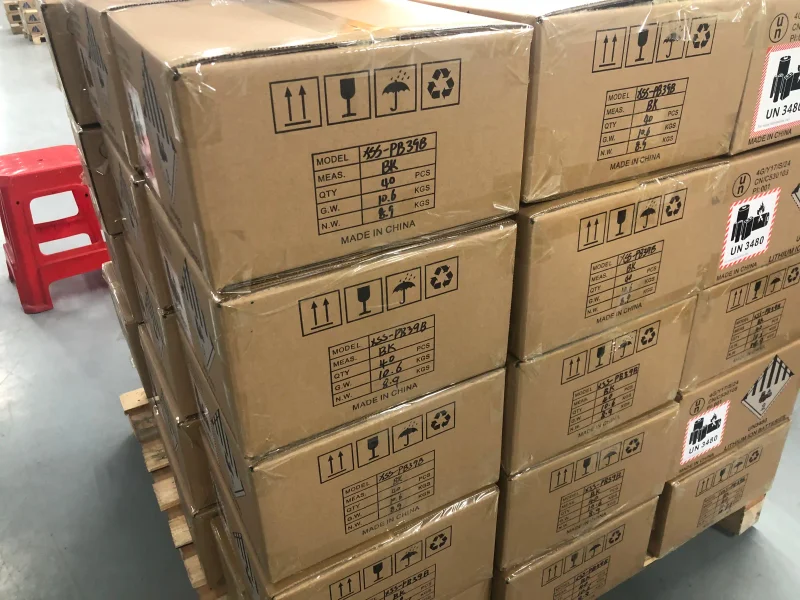
OEM shipment ready for export at WOWOHCOOL Shenzhen: palletized chargers with commercial invoice, packing list, and certificate of origin, FOB or DDP door-to-door available for US, EU, and UK importers
| Mode | Transit Time | Typical Rate | Best For |
|---|---|---|---|
| Sea Freight (FCL) | 25-35 days | $1,500-3,000 per 40ft to US West Coast | Bulk orders 15+ CBM |
| Sea Freight (LCL) | 28-40 days | $65-90 per CBM | Mid-size orders 2-15 CBM |
| Air Freight | 5-10 days | $4-7 per kg all-in | Mid-volume, time-sensitive |
| Express Courier (DHL/FedEx) | 3-7 days | $5-8 per kg | Samples, under 100kg |
The Weight vs. Volume Rule
Carriers charge on whichever is greater: actual weight or volumetric (dimensional) weight. The standard volumetric divisor is 6,000 cubic centimeters per kg for air, 1 cubic meter per 167 kg for sea. Compact GaN chargers benefit here: a 65W GaN unit ships at roughly 0.3kg volumetric weight, allowing 30% more units per carton than legacy silicon designs. Our packaging engineers optimize carton dimensions to hit the weight breakpoint, not waste volumetric space.
Power Banks: Dangerous Goods Surcharges
Power banks ship as UN3480 (loose batteries) or UN3481 (batteries packed with equipment). Air freight surcharges for lithium DG typically add $0.50-1.50 per kg. Some carriers refuse loose batteries entirely, accepting only UN3481 in finished products. Sea freight handles lithium DG more economically but requires proper IMDG Code labeling, container segregation, and a Dangerous Goods Declaration filed by your forwarder.
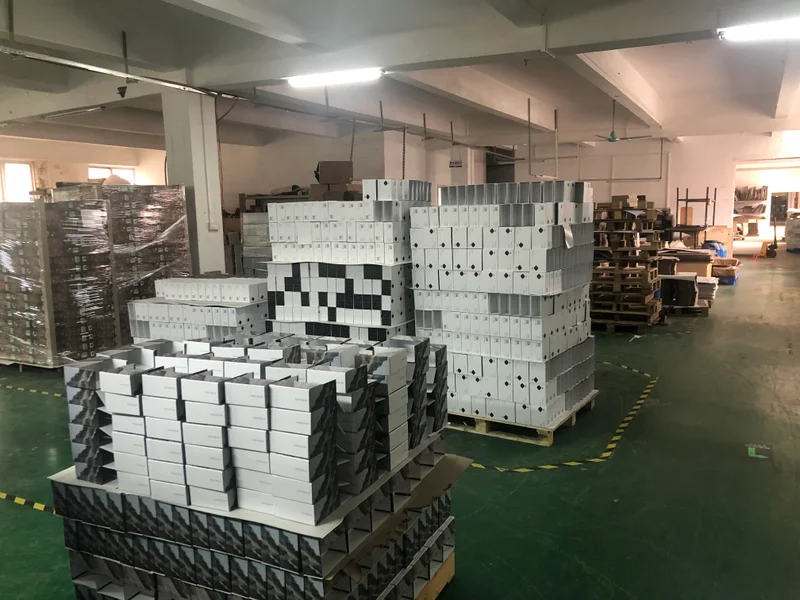
Optimized export packaging reduces volumetric weight charges and damage risk during 25-35 day ocean transit
Peak Season Surcharges
Pre-holiday peak (August through October) typically pushes ocean rates 20-40% above off-peak. Q4 inventory restocking causes the same spike for trans-Pacific routes. Planning your production calendar around these windows can reduce annual logistics costs by 10-15%, particularly for retail-bound seasonal SKUs. Our shipping from China guide covers Incoterms, rate negotiation, and forwarder selection in detail.
5. OEM Landed Cost Formula: FOB to DDP Calculation
Total landed cost is the only number that matters when you build a wholesale price or model an Amazon FBA margin. The formula below reflects the 2026 US tariff stack and assumes ocean LCL freight from Shenzhen.
Landed Cost = FOB + Freight + Insurance + (FOB × Section 301) + (FOB × Section 122) + (FOB × MFN) + MPF + HMF + ISF + Customs Bond + Broker + Drayage + 3PL Receiving
Worked Example: 5,000 GaN Chargers, Shenzhen to Los Angeles
A B2B procurement order for 5,000 units of a 65W GaN charger at $12.00 FOB, shipped LCL ocean freight to a Los Angeles 3PL warehouse:
Result: a 38% landed-cost premium over $12.00 FOB. Section 301 plus Section 122 alone account for $4.20 of the $4.58 uplift.
Defect Amortization (3% AQL)
Even with a robust 4-stage QC process, factor a 3% AQL defect rate into your effective unit cost. On the 5,000-unit example: 150 defective units × $16.58 = $2,487 absorbed across 4,850 sellable units, adding $0.51 per unit. Build this buffer into your wholesale price before negotiating retail margins.
5 Hidden Costs Most Importers Miss
- CBP exam fees: Random container exams cost $250-1,200 plus demurrage during the hold.
- Demurrage and detention: Free time at US ports is typically 4-7 days; overruns cost $150-300 per container per day.
- FBA prep rejection: Amazon FBA rejects roughly 2-5% of inbound cartons for label or packaging issues, adding $0.50-1.20 per unit in rework.
- Currency hedging gap: USD/CNY can shift 2-5% over a 90-day order cycle. Build a 3% buffer or negotiate USD pricing.
- Sample and inspection costs: Pre-shipment AQL inspection runs $250-350 per day; engineering samples add $50-200 per SKU before bulk production.
6. Incoterms 2020: FOB, EXW, DDP, CIF
Your Incoterm choice determines who pays for what, where risk transfers, and how customs values are calculated. Choosing the wrong Incoterm can inflate dutiable value or expose you to logistics complexity you are not equipped to handle. Below is a B2B-friendly breakdown for charger imports.
FOB Shenzhen (B2B Default)
Supplier covers: production, inland trucking to port, export customs clearance, terminal handling, loading onto vessel.
You arrange: ocean freight, marine insurance, destination port clearance, drayage, duty payment.
Best when you have an established freight forwarder. Customs value equals FOB price, which keeps the duty base low.
EXW Shenzhen Factory Gate
Supplier covers: production only. Goods released at the factory loading dock.
You arrange: everything from inland trucking through final delivery, plus China export customs filing.
Lowest unit price but maximum operational complexity. Best for high-volume importers with a Chinese forwarder partner.
DDP to Your Door
Supplier covers: everything including duty payment, destination clearance, and final delivery.
You arrange: nothing logistically. Single all-in price.
Best for first-time importers or those wanting budget certainty. Premium of 15-30% over FOB depending on destination and volume.
CIF (Cost, Insurance, Freight)
Supplier covers: goods, ocean freight to destination port, marine insurance.
Watch out: customs value includes freight and insurance, which inflates the duty base by roughly 1.5-3% of FOB.
Common but rarely the cheapest landed option. Many importers prefer FOB + their own forwarder for transparency.
WOWOHCOOL Quote Format: Our default quote is FOB Shenzhen with optional DDP add-on. We also offer EXW for buyers consolidating shipments across multiple Shenzhen suppliers and CIF for Letter of Credit transactions where banks require it. Compare both options side by side before deciding.
7. Import Documentation Requirements for OEM Buyers
Customs holds typically come from missing or inconsistent paperwork, not from product defects. The documents below are the minimum required for a clean import; we provide all of them with every export shipment, signed and timestamped.
Commercial Invoice & Packing List
Itemized values, HS codes, country of origin, gross and net weights, and carton counts. The invoice is the primary basis for duty calculation; declared values must match your purchase order and broker entry summary exactly.
HS Classification Certificate
Signed factory document confirming the 10-digit HTSUS subheading. We reference current CBP rulings and the USTR exclusion list, cross-checked against the USITC HTS Search tool. This is your primary defense against post-entry audits and reclassification penalties.
MSDS & UN38.3 (Power Banks)
Material Safety Data Sheet plus UN38.3 test summary are mandatory for any lithium battery shipment. Air freight forwarders will refuse loose batteries (UN3480) without these. WOWOHCOOL maintains UN38.3 certificates for every active power bank SKU.
Certificate of Origin (CO)
Form A or generic CO certifies country of manufacture for duty assessment. Required for FTA preferences (none currently apply to China) but useful for documenting non-IEEPA jurisdictions if you split shipments across origins.
ISF Filing (US Imports)
Importer Security Filing must be submitted to CBP at least 24 hours before vessel departure from China. Late or incorrect ISF triggers $5,000 penalties per violation. Your forwarder usually handles this; we provide the data points within 48 hours of booking.
Bill of Lading or Air Waybill
The carrier-issued shipping document. Original BoL release is required for cargo pickup at destination unless you use a Telex Release or Sea Waybill. Confirm release type with your forwarder before vessel departure to avoid demurrage.
For region-specific compliance like CE, FCC, UL, PSE, or KC marks, see our US & EU certifications guide. For a deeper dive on factory documentation standards, see our verification checklist.
8. Payment Methods & Banking Costs
Bank fees and exchange rate timing add a quiet 0.5-3% to landed cost on every order. The right payment method depends on order size, supplier relationship, and risk tolerance.
| Method | Fee | Speed | Best For |
|---|---|---|---|
| T/T Wire Transfer | $30-50 per transfer | 2-5 business days | Bulk orders (most common) |
| L/C (Letter of Credit) | 0.5-1.5% of order value | 5-10 business days | Large orders >$50,000 |
| Alibaba Trade Assurance | 0.5-2% of order value | 1-2 business days | First-time orders, buyer protection |
| PayPal | 4-5% plus fixed fee | Instant | Sample payments, small amounts |
Bank Transfer Optimization
T/T transfers carry intermediary bank fees of $15-30 on each end. Banks with direct China correspondent relationships (HSBC, Citi, Standard Chartered) save $20-40 per transaction. Consolidate into fewer larger transfers: a $10,000 wire and a $50,000 wire cost the same in bank fees, so batching reduces per-dollar overhead.
Currency Hedging
USD/CNY exchange rates can shift 2-5% over a 90-day production cycle. Forward contracts lock in the rate at order placement; many experienced importers build a 3% buffer into their pricing instead. WOWOHCOOL invoices in USD by default and updates pricing quarterly to reflect current FX trends.
Standard Practice: For first orders under $5,000, use Alibaba Trade Assurance or PayPal for buyer protection. For orders above $5,000, T/T with 30% deposit and 70% balance before shipment is industry standard. WOWOHCOOL accepts T/T, L/C, and Trade Assurance with flexible terms for repeat partners.
9. Marine Cargo Insurance
Marine insurance is the smallest line item that prevents the largest losses. Premium typically runs 0.1-0.5% of cargo value but covers physical loss, theft, and damage during 25-35 day ocean transit. Most B2B importers under-insure or skip insurance entirely until the first lost container forces the conversation.
All-Risk Coverage
Covers all physical loss or damage from external causes during transit, with limited exclusions. Recommended for high-value electronics shipments. Premium: 0.3-0.5% of cargo value plus 10% buffer for full replacement value.
Named Perils Coverage
Covers only specified risks (fire, explosion, collision, jettison). Lower premium at 0.1-0.3% but excludes theft, moisture damage, and rough-handling losses. Best for low-margin commodities, not for chargers or batteries.
When to File a Claim
Document any container damage at pickup with photos, joint surveys, and a written notice of claim within 3 days of delivery. Most claims are settled within 30-60 days when paperwork is complete: bill of lading, commercial invoice, packing list, marine insurance policy, and survey report. WOWOHCOOL provides full export documentation that supports both Customs entry and insurance claim processing.
WOWOHCOOL offers CIF pricing with All-Risk insurance included, or FOB pricing if you prefer to arrange your own coverage through your forwarder. We coordinate documentation regardless of who issues the policy.
10. The IEEPA Refund Window: A 2026 Checklist
If your factory shipped to the US between April 2025 and February 2026, you likely paid the 54% IEEPA reciprocal tariff. After the Supreme Court ruling, those duties are recoverable. The refund window is real but tight. Below is the action sequence our compliance team uses to support B2B clients filing protests and Post Summary Corrections.
Step 1: Identify Eligible Entries
Pull all entry summaries (CBP Form 7501) from your customs broker for entries between April 2025 and February 24, 2026. Look for line items showing IEEPA tariff codes (HTS 9903.01.xx series for reciprocal tariffs). Section 301 line items remain owed and are not refundable.
Step 2: Check Liquidation Status
Entries typically liquidate roughly 314 days after entry. Unliquidated entries can be corrected via Post Summary Correction (PSC), which is faster and cheaper. Liquidated entries require a formal protest filed within 180 days of liquidation.
Step 3: File PSC or Protest
Your customs broker files the PSC or protest with supporting documentation: entry summary, commercial invoice, signed HS classification certificate, and the relevant CBP guidance citing the Supreme Court ruling. Protests denied at the broker level can be escalated to the Court of International Trade.
Step 4: Track Refund Disbursement
CBP refunds typically arrive 60-180 days after approval. The broker who filed the PSC or protest is the disbursement contact. Refund interest accrues at the federal short-term rate from the date of original payment.
Section 122 Refund Outlook
In May 2026, the Court of International Trade struck down Section 122 for named plaintiffs. For non-plaintiff importers, the 10% surcharge remains payable until the July 24, 2026 sunset. If Congress lets it expire and no further legal action extends jurisdiction, refund eligibility for Section 122 may expand. Track CIT and Federal Circuit decisions through Q3 2026.
Refund Math Example: An importer who paid the 54% IEEPA tariff on a $200,000 FOB shipment of GaN chargers in October 2025 has a recoverable amount of approximately $108,000, less broker filing fees of $500-1,500. WOWOHCOOL provides signed HS classification certificates retroactively to support these claims at no charge for repeat customers.
11. The WOWOHCOOL Documentation Advantage
"Many first-time importers focus only on the factory price and forget that shipping and duties can add 35-50% to their total cost in 2026," says Snowy May, Market Manager at WOWOHCOOL. "We help our clients understand the full landed cost upfront so there are no surprises when the shipment arrives."
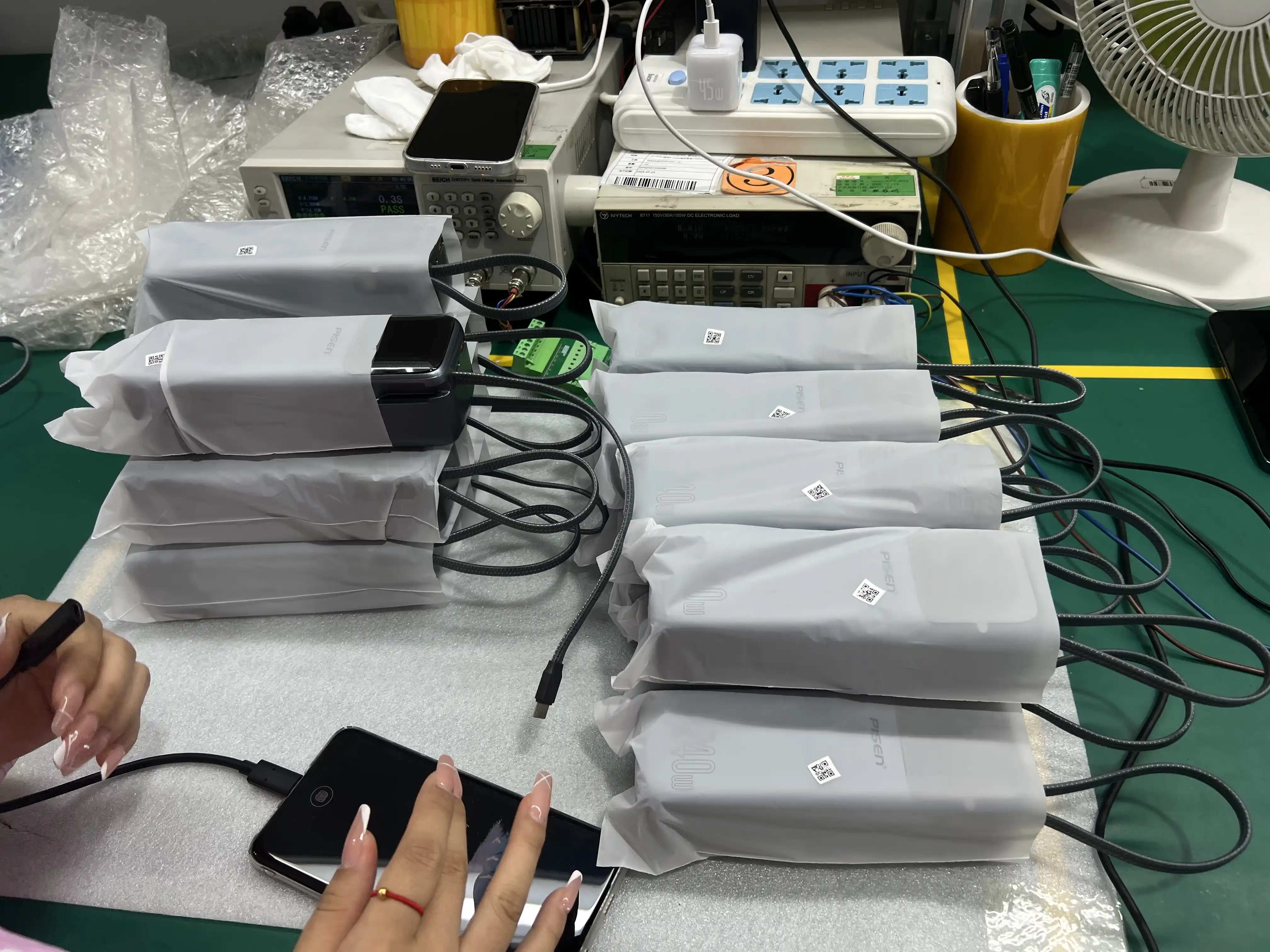
Laptop power bank pre-shipment sampling inspection: every imported batch requires QC documentation including capacity test reports, UN38.3 certificates, and commercial invoice with correct HS code, WOWOHCOOL provides complete documentation package with every OEM order
Since 2013, our 5,000 square meter ISO 9001 certified facility in Shenzhen has shipped to 50+ countries with full FOB Shenzhen, EXW, and DDP options. Standard OEM lead time is 25-30 days with sample turnaround in 3-7 days. Every export ships with signed HS classification certificates, MSDS, UN38.3 test summaries, certificates of origin, and complete commercial documentation.
200+
Global brands served since 2013
1M+
Units monthly production capacity
50+
Countries shipped with full DG documentation
For a deeper look at how to evaluate a manufacturer before placing your first PO, see our factory selection guide. To compare OEM and ODM partnership models, see our OEM vs ODM comparison. For QC process details that affect defect amortization in your landed cost, see our quality control guide.
12. Frequently Asked Questions
What is the current import duty on chargers from China in 2026?
GaN and wall chargers (HS 8504.40) face approximately 35% combined US duty in mid-2026: 0% MFN base + 25% Section 301 + 10% Section 122 transitional surcharge. Power banks (HS 8507.60) face ~38.4% (3.4% MFN + 25% Section 301 + 10% Section 122). Plus MPF 0.3464%, HMF 0.125%, and customs broker fees. EU duty rates remain 0-3.7% MFN + VAT 19-27%.
Did the Supreme Court eliminate tariffs on Chinese chargers in 2026?
No. The February 20, 2026 ruling struck down only IEEPA-based tariffs (the 54% reciprocal China surcharge). Section 301 remained intact, so the 25% surcharge on chargers and power banks still applies. The administration replaced IEEPA with a 10% Section 122 transitional surcharge effective February 24, 2026.
Can I claim a refund for IEEPA tariffs paid in 2025?
Yes. IEEPA tariffs paid between April 2025 and February 2026 are recoverable via Post Summary Correction (unliquidated entries) or formal protest within 180 days of liquidation. Document the entry summary, broker invoices, and tariff line items. Section 301 duties paid during the same period are not refundable. WOWOHCOOL can provide signed export documentation to support refund claims.
What is HS code 8504.40 used for?
HS 8504.40 covers static converters, including GaN chargers, wall adapters, car chargers, and power supplies. This is the most common classification for charging accessories. Wireless chargers may fall under HS 8504.40 or HS 8543.70 depending on construction. Power banks use HS 8507.60. Misclassification can cost 5-15% in overpaid duty, always request a signed HS classification certificate from your factory.
What is the difference between FOB and DDP shipping for chargers?
FOB (Free on Board) means the supplier covers costs until goods are loaded onto the vessel at Shenzhen port; you arrange and pay for international freight, insurance, import duties, and destination clearance. DDP (Delivered Duty Paid) means the supplier handles everything door-to-door, including duties and customs clearance. DDP typically costs 15-30% more than FOB but eliminates customs paperwork and surprise charges. WOWOHCOOL offers both FOB and DDP shipping options.
What documents are required to import chargers from China to the US?
Standard documents include commercial invoice, packing list, bill of lading or air waybill, certificate of origin, and HS classification certificate. Power banks additionally require MSDS (Material Safety Data Sheet) and UN38.3 test summary for lithium battery shipping. ISF filing is required 24 hours before vessel departure for ocean freight. WOWOHCOOL provides complete documentation packages with every OEM order, including CE, FCC, RoHS, and UL certification support.
Are power banks subject to higher tariffs than chargers in 2026?
Yes. On January 1, 2026, the Section 301 surcharge on non-EV lithium batteries jumped from 7.5% to 25%, raising the total duty stack on power banks (HS 8507.60) to approximately 38.4% in mid-2026. This is roughly 3 percentage points higher than chargers (HS 8504.40), making hybrid 2-in-1 SKU classification an increasingly valuable cost optimization strategy.
How do I calculate total landed cost for charger imports from China?
Total landed cost = FOB price + ocean or air freight + insurance + Section 301 duty + Section 122 duty + MFN duty + MPF (0.3464%) + HMF (0.125%) + ISF filing + customs broker fees + drayage + 3PL receiving. For a typical $10 FOB charger in 5,000-unit lots, expect approximately $13.50-14.50 landed at a US warehouse, a 35-45% premium over FOB. Request a landed cost quote with current tariff calculations for your specific product.
Market Manager - Wireless Charging & Import Compliance
10+ years in wireless charging, power bank market analysis, and B2B import compliance. Tracks Section 301 updates, USTR Federal Register notices, and CBP rulings to keep WOWOHCOOL DDP quotes current to the day.
Factory Footprint
ISO 9001 Facility
Shenzhen, China
Export Countries
Engineers In-House
Need a 2026 Landed Cost Quote?
WOWOHCOOL provides full HS classification, MSDS, UN38.3 documentation, and DDP shipping options. Get a complete landed cost quote with current Section 301 and Section 122 calculations within 24 hours.