
Power Bank OEM Manufacturer: Custom & Wholesale Sourcing Guide

Supply Chain Expert · 10+ years in OEM/ODM Manufacturing
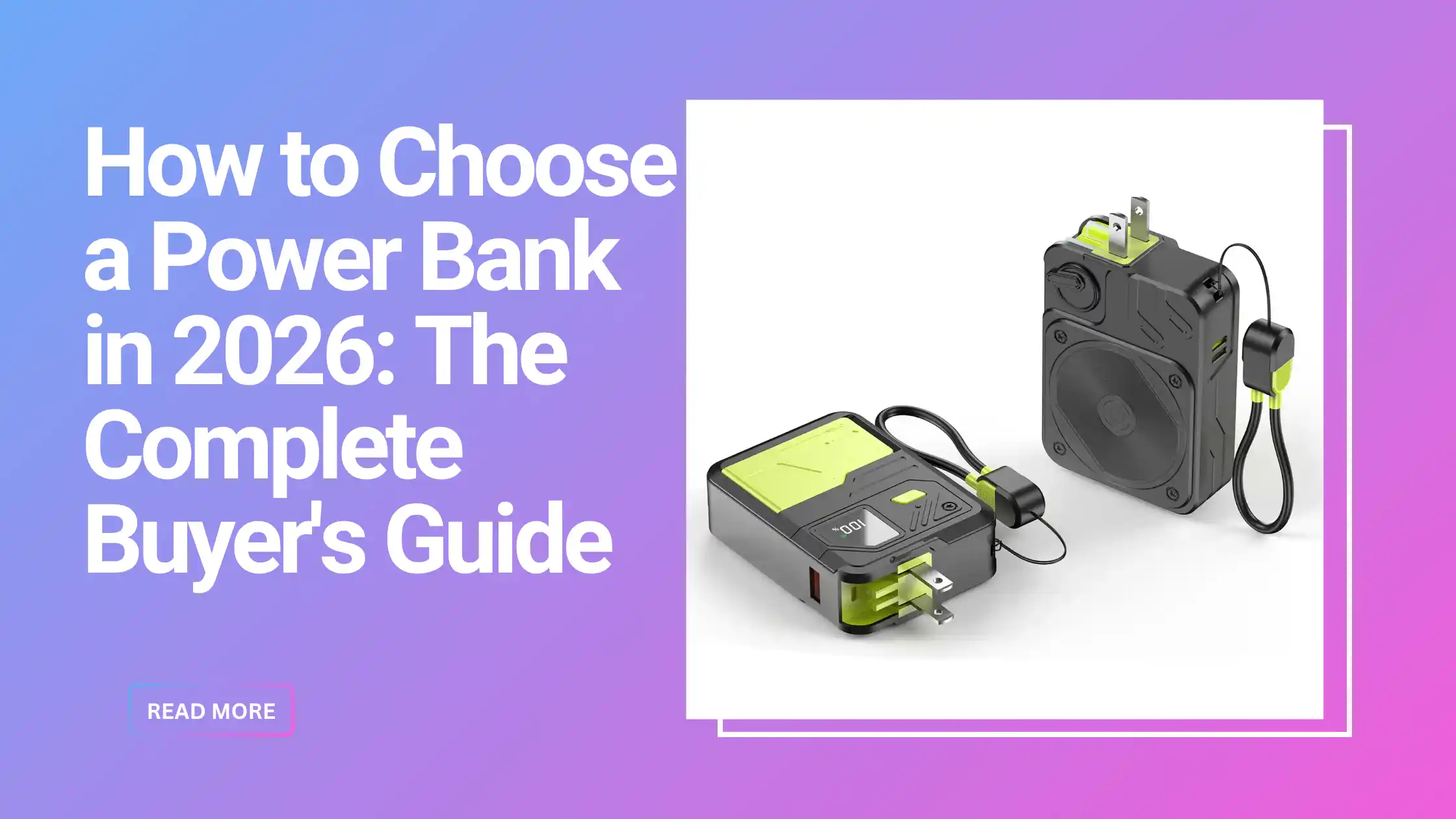
For brands and importers, the OEM sweet spot is a 10,000mAh power bank with 20-30W USB-C PD, MOQ 500, FOB $4-7/unit. The global market surpassed $16.4 billion in 2026, with Shenzhen producing over 80% of supply. New technologies, semi-solid-state batteries, Qi2 magnetic wireless, GaN V delivery, have reshaped the OEM landscape. This guide covers B2B sourcing fundamentals: capacity tier strategy with FOB pricing, MOQ flexibility from 500 units, certification requirements (CE/FCC/UL/UN38.3), Grade-A cell verification, and private label branding options, with real factory pricing from Shenzhen's manufacturing hub.
Key Takeaways
- Match power bank capacity to your target retail price point, not just mAh. 5,000mAh retails $12-19; 10,000mAh retails $19-29; 20,000mAh retails $29-49; 20,000mAh 65W laptop-capable retails $49-79. The highest-margin segment is 10,000mAh with digital display and built-in cables ($25-35 retail, $5-7 FOB at MOQ 500).
- 3 non-negotiable specs for 2026 OEM power banks: (1) USB-C PD 3.1 with PPS (covers iPhone, Samsung, Pixel, and laptops with one port), (2) at least one USB-A port for legacy device compatibility, (3) pass-through charging (charge the power bank while it charges your device). Missing any of these = lost sales to competitors who include them.
- Cell choice determines your warranty liability: Grade-A cells (LG, Samsung SDI, Panasonic) deliver rated cycles with under 2% failure rate over 12 months. Grade-B cells (generic Chinese) save $0.30-0.50/unit but generate 5-8% warranty returns. For a 10,000-unit order, that's the difference between 200 returns and 800 returns, the cell savings are wiped out by return shipping and replacement costs.
- Built-in cable vs port-only: built-in cables increase retail conversion by 18-25% (consumers prefer grab-and-go) but add $0.50-1.00 to BOM cost and are the #1 mechanical failure point. The 2026 sweet spot: one built-in USB-C cable + one additional USB-C port + one USB-A port. Cover the convenience buyer and the power user in one SKU.
Table of Contents
1. mAh Capacity for OEM Buyers: Rated vs Usable & Cell Conversion Efficiency
For OEM buyers specifying power bank cells, the gap between a cell's rated mAh and real-world usable capacity is the single most important technical specification to verify. Here's what mAh actually means and how to evaluate supplier claims.
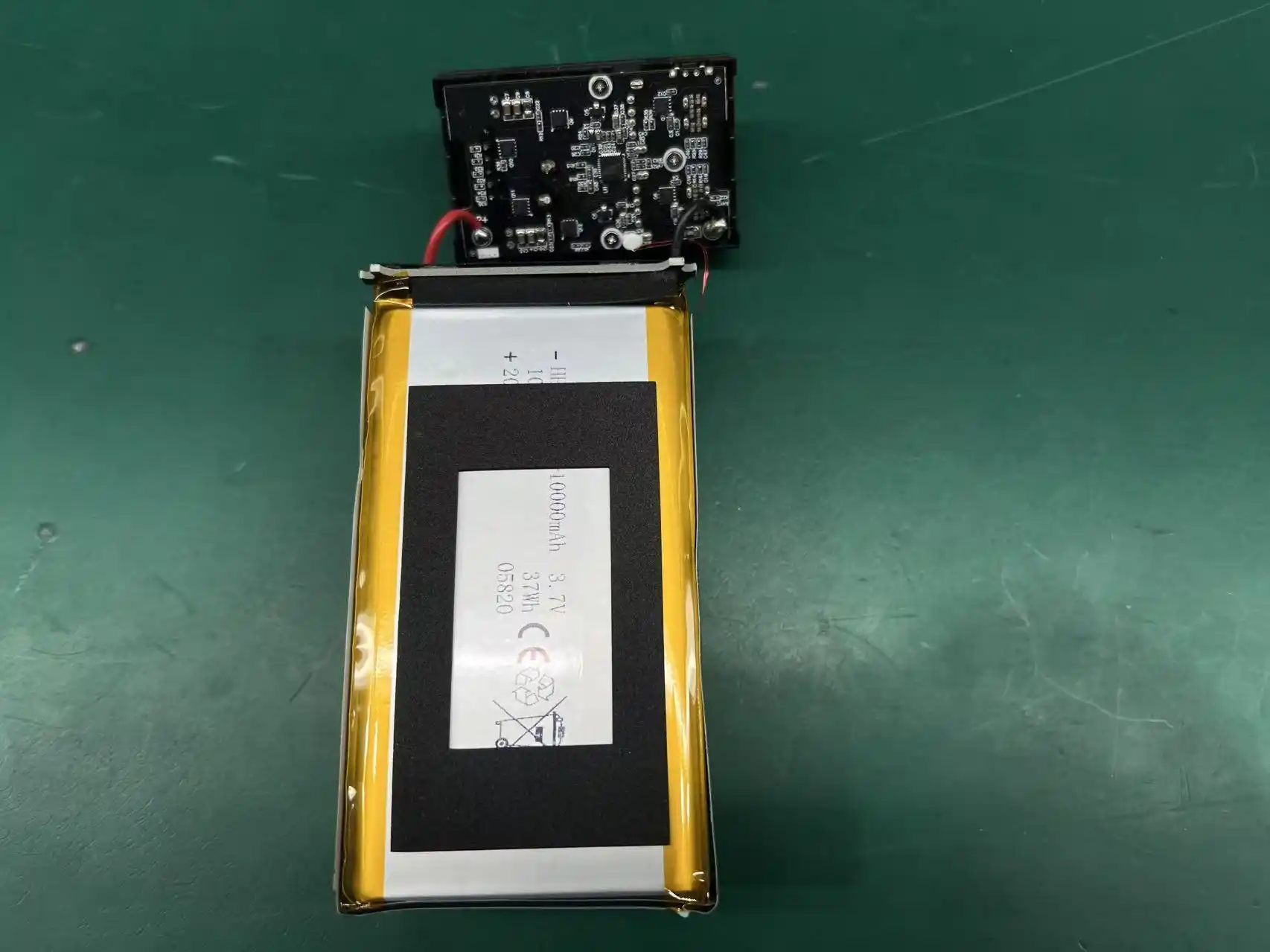
Internal battery cell construction: Grade-A Li-Po cells with individual V-0 separation walls and dual-NTC thermal sensors per IEC 62368-1 Ed.3, critical verification points for OEM power bank buyers
Rated vs Usable Capacity: The 60-70% Rule
Power bank capacity is measured at the internal battery voltage of 3.7V, but USB output requires 5V or higher. During this voltage step-up conversion, energy is lost as heat. The result: you only get about 60-70% of the rated capacity as usable output.
The Conversion Formula
Usable mAh = (Rated mAh × 3.7V × Efficiency) ÷ 5V
Example: 10,000mAh × 3.7V × 0.85 ÷ 5V = ~6,290mAh usable
Premium power banks with GaN technology achieve 85-92% conversion efficiency. Budget models typically manage 60-75%. This is why two "10,000mAh" power banks can deliver noticeably different real-world performance. For a deeper technical breakdown, read our Power Bank Specs Guide.
Retail Packaging Reference: Estimated Full Charges by Device & Capacity
Use this reference table for retail packaging claims and Amazon product listings. All estimates based on conservative 65% conversion efficiency, OEM best practice: print the formula basis on packaging to reduce capacity-related returns.
| End-User Device | 5,000mAh (Budget Tier) | 10,000mAh (Volume Tier) | 20,000mAh (Premium Tier) |
|---|---|---|---|
| iPhone 15/16 (~3,300mAh) | ~1 charge | ~1.5-2 charges | ~3.5-4 charges |
| iPhone 16 Pro Max (~4,500mAh) | ~0.7 charges | ~1.2-1.5 charges | ~2.5-3 charges |
| Galaxy S25 Ultra (5,000mAh) | ~0.6 charges | ~1.1-1.3 charges | ~2.3-2.6 charges |
| Pixel 9 Pro (~4,700mAh) | ~0.7 charges | ~1.2-1.4 charges | ~2.5-3 charges |
| iPad Air (~7,500mAh) | ❌ Not practical | ~0.7 charges | ~1.5-2 charges |
*All estimates assume 65% conversion efficiency (industry-standard conservative baseline). Premium GaN-based circuits at 85-92% efficiency deliver 20-30% more real-world charges. OEM brands using GaN circuits may claim higher numbers with supporting test data.
2. Capacity Tier Strategy: 5,000-27,000mAh with FOB Shenzhen Pricing
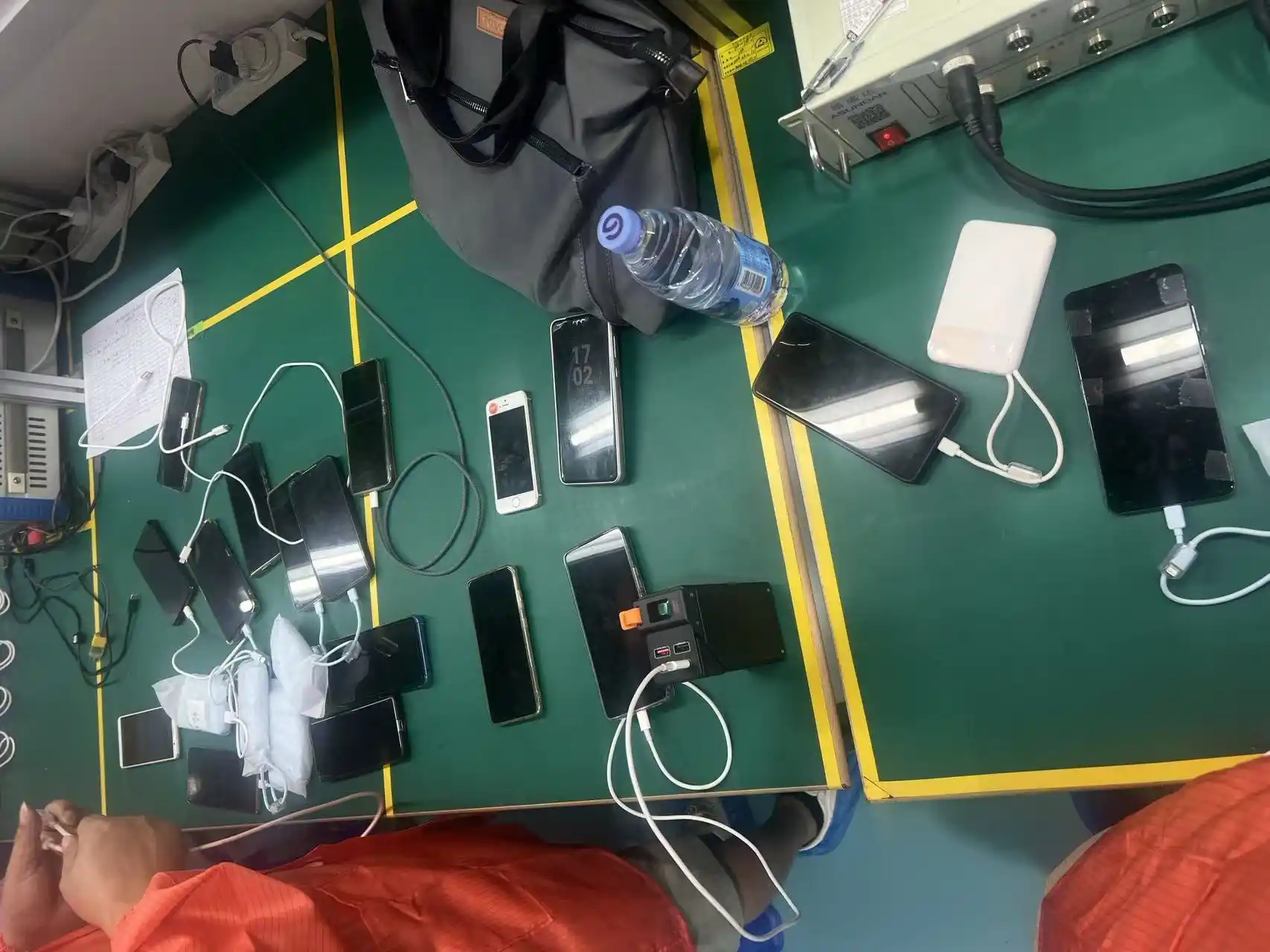
Multi-device phone compatibility testing: every OEM power bank SKU validated across iPhone, Samsung Galaxy, and Google Pixel, ensuring 100% charging protocol handshake before mass production
OEM Market Position: Ultra-portable entry tier, keychain and credit-card form factors. Lowest BOM cost, OEM production turnaround 25-30 days after sample approval. Best paired with semi-solid-state cells (as thin as 6.8mm) for premium differentiation.
Target retail: $12-20. MOQ 500. Ideal first SKU for brands testing the market. Margin is thin on standard Li-polymer cells; semi-solid-state variant commands 2-3× retail premium. See semi-solid-state OEM guide →
OEM Market Position: Captures 47.89% of global market share, the volume driver for any power bank brand. GaN circuitry at this tier delivers 85-92% conversion efficiency vs 60-65% for budget designs, directly impacting retail reviews and return rates.
Target retail: $20-40. MOQ 500. This is the tier where GaN vs non-GaN BOM decisions have the highest margin impact. Recommend 2-3 port variants (USB-C PD 20-30W + USB-A) to cover the broadest consumer base. WOWOHCOOL ships more 10,000mAh OEM units than all other tiers combined.
OEM Market Position: Travel and multi-device segment, 74Wh falls comfortably within IATA 100Wh carry-on limit (no airline approval needed). Higher BOM cost but higher retail margin ($40-60). Best paired with 65W+ PD output for tablet/ultrabook charging capability as a key differentiator.
Target retail: $40-60. MOQ 500. Key certification requirements: UN38.3, CE, FCC, UL. 65W PD 3.0 output recommended as minimum to justify the 20,000mAh premium over 10,000mAh tier. Multi-port (2C1A) configuration is standard expectation at this tier.
OEM Market Position: Laptop charging and professional segment, 99.9Wh sits exactly at the IATA 100Wh passenger aircraft limit. Requires 65-100W PD 3.1 EPR output to differentiate from 20,000mAh tier. Highest retail price point ($60-100+).
Target retail: $60-100+. MOQ 500. Niche tier, only recommend for brands with established laptop accessory channels. EPR-rated cable must be included in-box (adds $2-4 to BOM). Airline compliance documentation (UN38.3 + Wh labeling) is mandatory for all distribution channels. Best combined with TFT display for real-time wattage monitoring as premium justification.
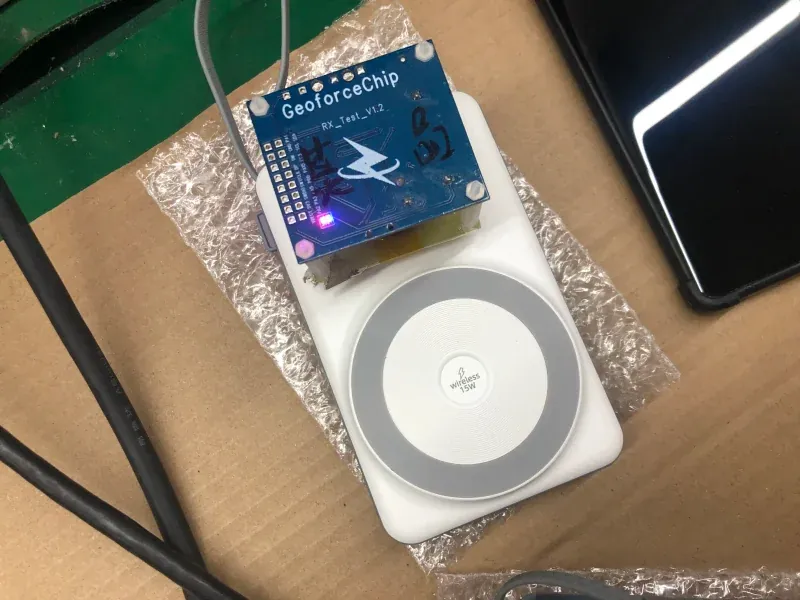
3. OEM Output Wattage Selection: Matching PD Specs to Your Target Market
For OEM product planners, output wattage determines which market segment your power bank serves, from budget smartphone users (18-20W) to premium laptop owners (65-100W). mAh tells you how much power; wattage tells you how fast it delivers. Both matter equally.
| Output Wattage | OEM Product Positioning | Target Device Segment | FOB Cost Impact |
|---|---|---|---|
| 10-12W (5V/2A) | Entry-level, budget retail. Legacy USB-A only. Not recommended for new OEM products in 2026. | Earbuds, smartwatch, giveaways | Baseline, lowest BOM |
| 18-20W (USB-C PD) | Entry smartphone tier. Minimum viable spec for any new 2026 OEM power bank. | iPhone fast charge (0-50% in ~30 min) | +$0.50-1.00 vs 10W |
| 30W (USB-C PD + PPS) | Flagship phone tier, highest volume premium segment. PPS enables Samsung Super Fast Charging and iPhone 27W. | Galaxy S Ultra, iPhone Pro Max, Pixel Pro | +$1.00-2.00 vs 20W ★ |
| 45-65W (USB-C PD 3.0) | Tablet/ultrabook tier, fastest-growing OEM segment driven by EU USB-C laptop mandate from April 2026. | iPad Pro, MacBook Air, Surface, Dell XPS | +$3.00-5.00 vs 30W |
| 100W+ (PD 3.1 EPR) | Laptop replacement tier, premium margin, lower volume. Requires EPR-rated e-marker cable in-box. | MacBook Pro 16", gaming laptops, workstations | +$8.00-15.00 vs 65W |
OEM Product Planning Rule: Market the Wattage Your Customer's Device Actually Uses
A 100W power bank won't charge an iPhone faster than a 30W bank, the iPhone caps at ~27W regardless of the power source. For OEM brands, this means: marketing claims should reference the end device's actual maximum input, not the charger's theoretical ceiling. A 100W power bank marketed to iPhone users generates returns and negative reviews when customers realize they paid for wattage they can't use. For smartphone-dominant markets, 20-30W output is the optimal balance of BOM cost and marketable performance. Reserve 65W+ for product lines specifically targeting laptop and tablet users.
4. Port Configuration: USB-C PD, USB-A & Qi2 Wireless
USB-C PD: Mandatory Baseline for 2026
Every new OEM power bank design in 2026 must include bi-directional USB-C with PD 3.0 minimum (PD 3.1 recommended for 65W+). The EU Common Charger Directive makes USB-C mandatory for all new devices. OEM specification priority: bi-directional PD (the port handles both input recharge and output charging), with PPS support for Samsung and iPhone fast-charge compatibility. USB-C PD Fast Charging Guide →
USB-A: Legacy Compatibility Port
Include one USB-A port (10-18W) for backward compatibility with Micro-USB accessories, wireless earbuds cases, and markets where USB-A cables still dominate (Southeast Asia, Africa, Latin America). Minimal BOM cost adder. For premium EU/US SKUs, a USB-C-only design with an included C-to-A adapter reduces BOM and simplifies the industrial design. Not recommended as the primary output port on any new 2026 OEM product.
Qi2 Magnetic Wireless: Premium Add-On Tier
Qi2 magnetic output (15W, N52H magnets) adds $2-4 to BOM but enables a distinct premium SKU tier. Wireless efficiency is inherently lower (70-80%) vs wired (85-92%), and Qi2 generates more heat, both points must be managed in product spec claims to avoid returns. Qi2.2 (25W) is the emerging premium standard. OEM best practice: offer Qi2 wireless as a feature on 10,000mAh+ models, not as a standalone wireless-only SKU. Qi2 vs MagSafe Guide →
Built-in Cables: Niche Differentiation Feature
Integrated USB-C or Lightning cables add $1-3 to BOM and create a unique SKU differentiator for travel/commuter segments. Key OEM specification: demand reinforced strain relief rated for 10,000+ bend cycles, the built-in cable is the single highest-failure component. If the cable fails, the entire unit becomes e-waste, directly impacting warranty costs and brand reputation. Include cable replacement terms in the warranty policy.
5. 2026 Differentiators: GaN, Pass-Through & Semi-Solid-State Technology
GaN (Gallium Nitride) Technology
GaN power banks are smaller, cooler, and more efficient (90-92% conversion vs 80-85%). The size difference is significant, a GaN 10,000mAh bank is noticeably slimmer. Worth the modest premium. Learn more about GaN →
Digital Battery Display
LED dots (4 lights = 25% each) are imprecise. A digital percentage display tells you exactly how much power remains, critical when deciding whether to bring the bank or charge it before leaving. Look for LCD or TFT displays showing both percentage and charging wattage.
Pass-Through Charging
Can the power bank charge your devices while being recharged itself? This is essential for overnight use, plug the bank into the wall, plug your phone into the bank, and both are full by morning. Not all power banks support this; verify before buying.
Semi-Solid-State Battery
The newest battery technology: gel electrolyte replaces most of the flammable liquid in traditional Li-ion cells. Benefits include 2-3× longer lifespan (1,000-2,000 cycles), dramatically safer (no fire when punctured), and ultra-thin designs (as thin as 6.8mm). Premium price but genuinely better technology. Read our semi-solid-state guide →
6. OEM Battery Logistics: UN38.3, IATA Wh Limits & Air Freight Compliance
For importers and OEM brands, lithium battery shipping compliance is a supply chain requirement, not just a traveler's concern. UN38.3 certification, IATA watt-hour limits, and proper DG documentation determine whether your shipment clears customs or gets held at the port. Here are the rules governing power bank logistics as of 2026:
| Rule | Requirement |
|---|---|
| Carry-on ONLY | Power banks must be in carry-on luggage. NEVER in checked bags. If a fire starts in the cabin, crew can respond. In the cargo hold, it's undetectable. |
| Under 100Wh (~27,000mAh) | No airline approval needed. Unlimited quantity within reasonable personal use (typically up to 10-20). Most consumer power banks fall in this category. |
| 100-160Wh | Airline approval required. Limited to 2 per passenger. Covers large laptop power banks and professional equipment. |
| Over 160Wh | Prohibited on passenger aircraft. Cargo-only with dangerous goods declaration. |
How to Calculate Watt-Hours (Wh)
Wh = (mAh × Voltage) ÷ 1,000
For a 20,000mAh power bank at 3.7V: (20,000 × 3.7) ÷ 1,000 = 74Wh, well under the 100Wh limit.
For a 27,000mAh bank: (27,000 × 3.7) ÷ 1,000 = 99.9Wh, right at the limit.
7. Sourcing Decision Framework: MOQ, Certification & Lead Time
| Your Situation | Recommended Spec |
|---|---|
| Promotional giveaways & corporate gifts | 5,000mAh · 20W USB-C · ultra-slim · MOQ 500 |
| Amazon FBA first-SKU launch (<$15K budget) | 10,000mAh · 30W USB-C PD · dual-port · MOQ 500 ★ |
| Mid-market retail brand (2-3 SKU lineup) | 20,000mAh · 65W USB-C PD · 3+ ports · FOB $10-13 |
| Premium electronics brand (laptop-grade) | 20,000mAh+ · 65-100W PD 3.1 · GaN · FOB $14-22 |
| Wireless accessory brand (Qi2 differentiation) | 10,000mAh · Qi2 15W magnetic + 30W wired · N52H magnets |
| Outdoor & heavy-use equipment brand | 27,000mAh · 100W PD 3.1 · multi-port · IP53 option |
| Custom OEM project (any capacity tier) | Browse OEM power bank catalog → |
Frequently Asked Questions
What power bank capacity should OEM buyers choose for their target market?
10,000mAh is the highest-volume tier with 47.89% market share, the ideal entry SKU for new brands. FOB $4.50-7.00/unit at 1,000 pcs with Grade-A cells, retail $20-40. 5,000mAh targets the ultra-portable and corporate gift segment (FOB $3-5/unit). 20,000mAh 65W serves the travel and laptop-charging segment (FOB $10-14/unit). Start with 10,000mAh as the hero SKU, add 20,000mAh as the premium tier. 27,000mAh (99.9Wh) is the maximum airline-compliant capacity for international distribution.
How do OEM buyers verify a power bank factory's real capacity is genuine?
Five verification steps: (1) Request a live video factory tour matching the background to website photos. (2) Demand a complete BOM with cell supplier brands, FET part numbers, and batch test reports, refusal is a red flag. (3) Order 3-5 production-grade samples and test actual capacity with a USB power meter at 5V/2A discharge; a genuine 10,000mAh unit should deliver 6,000-6,500mAh usable output. (4) Verify ISO 9001 and any claimed certifications on the issuing body's public database. (5) Request 3 recent customer references in the target market. Grade-A cells from Samsung SDI, LG, or ATL deliver under 2% failure rate over 12 months vs 5-8% for generic cells.
What certifications do OEM importers need for power banks in the US and EU?
EU: CE, RoHS, REACH, UN38.3 (lithium battery transport, included in CE/FCC/RoHS package at $2,000-4,000, 4-6 weeks), WEEE registration. US: FCC Part 15B, UN38.3, UL 2056 (power-bank-specific safety, strongly recommended at $3,000-8,000, 2-3 months). Japan: PSE. South Korea: KC. Budget $1,500-5,000 total for certification testing, plan 8-12 weeks for global market readiness. GB47372-2026 compliance is mandatory for factory export from China starting April 2027. Always verify certificates on the issuing body's public database, not just supplier-provided PDFs.
What MOQ and FOB pricing should OEM buyers expect for power bank orders?
Laser engraving logo: MOQ 500 units. Silk screen logo: MOQ 1,000 units. Standard OEM (logo + color + packaging): MOQ 500-1,000 units. Full ODM with new mold: MOQ 1,000-3,000+ units. FOB Shenzhen pricing at 1,000 units: 5,000mAh ~$3-5, 10,000mAh ~$4.50-7, 20,000mAh ~$10-14, 27,000mAh ~$14-22. GaN circuit adds $1-3/unit; Qi2 wireless adds $2-4/unit. WOWOHCOOL offers flexible MOQ from 500 units with model mixing across SKUs. Payment terms: 30% deposit, 70% before shipment (T/T). Lead time: 25-30 days after sample approval.
GaN vs standard vs semi-solid-state, which battery technology gives an OEM brand the best margin?
GaN achieves 85-92% conversion efficiency vs 60-75% for silicon, the 25-point gap directly determines usable capacity. A 10,000mAh cell through 90% GaN delivers ~6,660mAh usable; through 65% silicon delivers ~4,810mAh. GaN adds $1-3 to BOM but enables 30% smaller PCB and 15-25% retail premium. Semi-solid-state offers 2,000-cycle lifespan, 30% higher energy density, near-zero thermal runaway risk, the strongest premium differentiator commanding 2-3× retail premium. Standard Li-polymer with GaN circuit is the optimal cost-performance combo for mid-tier OEM SKUs.
What wattage and port configuration sells best for OEM power banks in 2026?
USB-C PD is the mandatory baseline: 65W covers ~85% of ultrabooks, 140W PD 3.1 EPR covers all laptops. The 2C1A (2× USB-C + 1× USB-A) port layout is the 2026 standard. Qi2 magnetic wireless adds $2-4 to BOM but enables a premium SKU tier. Built-in cables are a niche differentiation feature. The optimal mass-market SKU: 10,000mAh, 65W GaN, 2C1A, digital battery display. The premium-tier SKU: 20,000mAh, 140W PD 3.1 EPR, Qi2 magnetic wireless, TFT display.
How do OEM buyers ship power banks internationally, UN38.3, IATA, and dangerous goods rules?
Power banks are Class 9 Dangerous Goods (UN3480/UN3481). Requirements: UN38.3 test certification (mandatory, $2,000-4,000, 4-6 weeks), MSDS documentation, batteries must ship at ≤30% charge state per IATA. ≤100Wh (~27,000mAh): standard DG cargo with proper labeling, carry-on without airline approval. 100-160Wh: airline approval required, max 2 units. >160Wh: prohibited on passenger aircraft. Logistics costs are 25-40% higher than standard electronics due to DG surcharges. Never ship undeclared lithium batteries, fines start at $50,000 per violation.
How do OEM buyers start sourcing power banks from Shenzhen factories?
Step 1: Define the target market, retail price point, and capacity, this determines certifications and BOM. Step 2: Choose from 29+ existing OEM power bank models or request custom ODM. Step 3: Request 3-5 production-grade samples (3-7 day turnaround) and test actual capacity, charging speed, and build quality. Step 4: Finalize branding and packaging, pay 30% deposit, production begins (25-30 days). Step 5: Use a lithium-battery-specialist forwarder for DG-compliant shipping. Request a no-obligation OEM quote with current FOB pricing and lead times →
Supply Chain Expert · Wireless Charging Specialist
Nina Nico is a supply chain management expert with 10+ years experience helping global B2B clients source quality power banks from WOWOHCOOL, a premium charging solution specialist in Shenzhen, China. She holds a degree in International Trade and is a certified supply chain professional (CSCP), with deep expertise in Qi2, GaN, and semi-solid-state battery manufacturing.
Factory Footprint
ISO 9001 Facility
Shenzhen, China
Export Countries
Engineers In-House
Ready to Launch Your Power Bank Brand?
WOWOHCOOL offers 29+ OEM power bank models from 5,000mAh to 27,000mAh. MOQ from 500 units, Grade-A cells, full certification support, and custom branding included.