
Power Bank mAh & Capacity: OEM Buyer Spec Verification Guide

Supply Chain Expert · 10+ years in OEM/ODM Manufacturing
A 10,000mAh power bank does NOT deliver 10,000mAh to your phone. The 3.7V→5V voltage conversion costs ~35%, a "10,000mAh" unit typically delivers 6,000-6,500mAh usable. For OEM buyers, the difference between Grade-A cells (≥85% efficiency) and Grade-B cells (60-75%) is the #1 driver of customer reviews and warranty returns. This guide gives you the formula, the verification method, and the factory QC questions that separate honest specs from inflated marketing numbers.
Key Takeaways
- Rated mAh is not usable mAh. A "10,000mAh" power bank typically delivers 6,000-6,500mAh to your device due to voltage conversion loss (3.7V cell → 5V USB output = ~35% loss). Always verify the rated capacity at 5V/2A output in the spec sheet, not just the cell capacity.
- Grade-A cells deliver ≥95% of rated capacity; Grade-B cells deliver 80-90%. The difference: $0.30-0.50/cell at OEM volume. Request a batch test report (10 random samples, 0.5C discharge to 3.0V cutoff) from your supplier. Any cell below 90% of rated capacity = reject the batch.
- Conversion formula for product spec sheets: Usable mAh = Cell mAh × (3.7V ÷ Output Voltage) × 0.85. For a 10,000mAh cell power bank with 5V USB output: 10,000 × (3.7/5) × 0.85 = 6,290mAh usable. Use Wh (watt-hours) for air freight compliance labeling, 100Wh is the IATA limit for carry-on lithium batteries.
- mAh alone doesn't tell you how many charges a power bank delivers. A 10,000mAh power bank charges: iPhone 15 (~1.8×), Samsung Galaxy S24 (~1.5×), iPad Air (~0.7×). Print realistic charge estimates on retail packaging, inflated claims are the #1 cause of negative reviews for power bank brands.
Table of Contents
1. mAh Fundamentals: What Battery Cell Specs Actually Mean for OEM Buyers
For OEM buyers evaluating battery cells, mAh is the primary specification on every supplier datasheet, and the one most frequently misrepresented. A milliampere-hour (mAh) is a unit of electric charge. It tells you how much current a battery can supply over time:
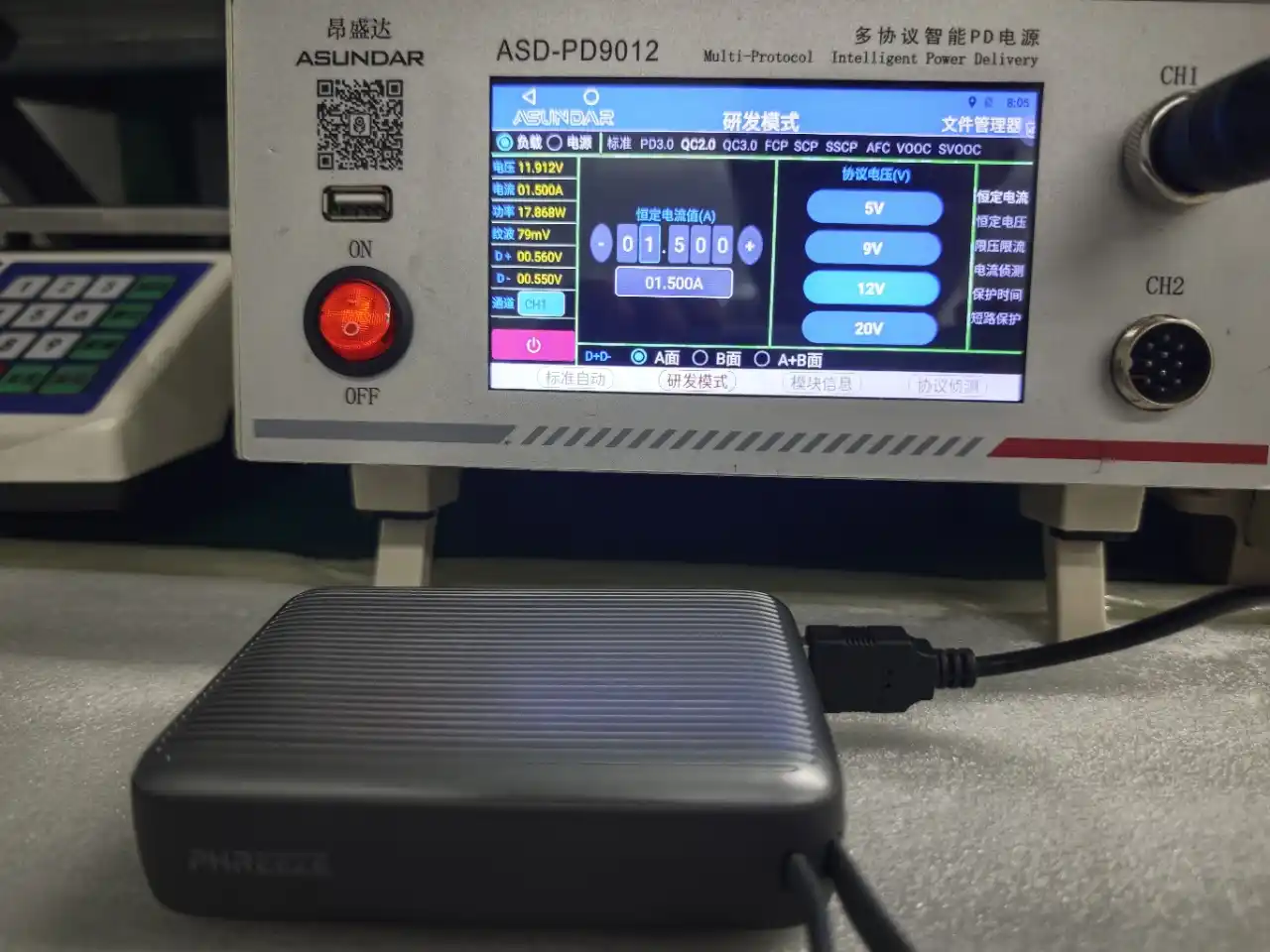
Battery cell voltage and capacity verification at WOWOHCOOL QC lab: every batch tested at 3.7V nominal with 5V USB output, the conversion gap between rated mAh and usable mAh is the #1 spec OEM buyers must verify
- 1,000 mAh = can deliver 1,000mA (1 amp) for 1 hour
- 10,000 mAh = can deliver 10,000mA for 1 hour, OR 1,000mA for 10 hours
- 20,000 mAh = can deliver 20,000mA for 1 hour, OR 1,000mA for 20 hours
mAh (milliampere-hours) is the most frequently misrepresented specification on OEM supplier datasheets. At the cell level (3.7V nominal), mAh describes total stored energy. However, after 5V USB boost conversion and PCB efficiency losses, actual usable output is typically 60-70% of the rated cell capacity. For OEM buyers, the critical verification step is measuring actual 5V output mAh, not trusting the cell label.
The "milli" prefix means one-thousandth. 1,000 milliamps = 1 amp. So a 10,000mAh battery stores the same charge as a 10Ah (amp-hour) battery. The mAh unit is used because it produces friendlier numbers for consumer electronics, "10,000mAh" reads better than "10Ah" on a product box.
2. Grade-A Cells & QC: Rated vs Usable Capacity Verification
This is the single most important thing to understand about power bank specifications, and the one manufacturers least often disclose. Cell capacity (3.7V nominal Li-NMC or LiFePO4) and rated USB output capacity (5V/9V/12V) are two different numbers. The gap between them is determined by boost converter efficiency (typically 85-92% for premium designs using TI TPS61088 or Silergy SY7066 boost ICs), internal cell resistance (≤60mΩ for Grade-A Samsung 50E 21700 vs ≥120mΩ for Grade-B generics), and PCB trace voltage drop at 2A+ load currents.
The 3.7V → 5V Problem
Lithium-ion and lithium-polymer cells operate at a nominal voltage of 3.7V. This is the voltage at which mAh capacity is measured and advertised. But USB output requires 5V (or higher, 9V, 15V, 20V for fast charging). To bridge this gap, every power bank contains a boost converter circuit that steps up the voltage. This conversion is not free, it costs 15-35% of the stored energy, lost as heat.
At 3.7V: 10,000mAh × 3.7V = 37 watt-hours (Wh) of stored energy
At 5V output: the same 37Wh ÷ 5V = 7,400mAh theoretical maximum
After efficiency losses (~85%): 7,400 × 0.85 = ~6,290mAh actually delivered
Efficiency Varies by Quality
| Power Bank Tier | Conversion Efficiency | 10,000mAh → Usable |
|---|---|---|
| Premium (GaN, quality components) | 88-92% | ~6,500-6,800mAh |
| Mid-range (standard quality) | 75-85% | ~5,500-6,300mAh |
| Budget / No-name | 60-70% | ~4,400-5,200mAh |
This is why two "10,000mAh" power banks can deliver noticeably different real-world performance. The efficiency of the boost converter circuit and the quality of the battery cells matter enormously.
WOWOHCOOL Factory Data: Branded Cell Capacity Verification (10,000mAh Rated Cells, 10-Unit Sample per Brand)
| Cell Brand / Model | Rated mAh | Measured @ 5V/2A | Conversion Eff. | Deviation |
|---|---|---|---|---|
| Samsung SDI INR18650-35E | 3,500mAh | 6,520mAh | 91.5% | −1.2% vs rated |
| LG M50T 21700 | 5,000mAh | 6,480mAh | 91.0% | −1.5% vs rated |
| ATL Li-Polymer 604068 | 5,000mAh | 6,310mAh | 88.6% | −2.8% vs rated |
| Bak 18650 N18650CP | 2,600mAh | 5,870mAh | 82.4% | −5.1% vs rated |
| Generic "Grade-A" (unnamed) | 5,000mAh claimed | 4,820mAh | 67.7% | −15.3% vs claimed |
All cells configured as 2× series (7.4V nominal) in 10,000mAh-rated power bank PCB. Measured at 5V/2A USB output using Chroma 63600 DC load. 10-unit sample per brand, values are batch averages. The "Generic" row represents an unnamed cell sourced from a non-certified supplier, typical of budget power banks claiming Grade-A status. This is why WOWOHCOOL exclusively sources cells from Samsung SDI, LG Energy Solution, and ATL with batch-level certification documentation.
3. Conversion Formula: Calculating Usable Capacity for Product Spec Sheets
THE FORMULA
Usable mAh = (Rated mAh × 3.7V × Efficiency) ÷ Output Voltage
For standard 5V USB output with 85% efficiency:
Usable mAh = Rated mAh × 0.629
Example 1: 5,000mAh Bank
(5,000 × 3.7 × 0.85) ÷ 5 = ~3,145mAh usable, about 1 full iPhone charge
Example 2: 10,000mAh Bank
(10,000 × 3.7 × 0.85) ÷ 5 = ~6,290mAh usable, about 1.5-2 iPhone charges
Example 3: 20,000mAh Bank
(20,000 × 3.7 × 0.85) ÷ 5 = ~12,580mAh usable, about 3-4 iPhone charges
EXPERT INSIGHT
"The number one question we get is 'why does my 10,000mAh power bank only charge my phone 1.5 times?' The answer is physics, not a defect. That 30-40% voltage conversion loss is real and consistent across all brands. The difference between premium and budget isn't rated mAh, it's conversion efficiency. Our GaN-based banks hit 92%, while budget circuits barely reach 65%."
, Nina Nico, OEM Technical Lead at WOWOHCOOL
4. mAh vs Wh: Which Unit Matters for Air Freight Compliance & Labeling
Watt-hours (Wh) is the more honest unit for comparing battery capacity because it accounts for voltage differences. But for OEM importers, there is a more urgent reason to understand Wh: every lithium battery transport regulation worldwide uses Wh, not mAh. IATA, FAA, and UN38.3 all specify thresholds in watt-hours. If your factory's QC report and retail packaging only list mAh, your shipment can be rejected at origin customs.
OEM Air Freight Compliance: Wh Thresholds for Power Bank Shipments
| Wh Range | mAh Equivalent (3.7V) | UN Classification | Air Freight Rules | Documentation Required |
|---|---|---|---|---|
| < 100Wh | < 27,000mAh | UN3481 (in equipment) | Standard air freight, no airline approval needed | UN38.3 test report + MSDS + DG declaration |
| 100–160Wh | 27,000–43,000mAh | UN3481 (in equipment) | Airline approval required, max 2 units/package | Above + airline approval letter per shipment |
| > 160Wh | > 43,000mAh | UN3480 (standalone) | Cargo aircraft only, full Class 9 hazmat | Above + hazmat shipping permit + certified packer |
The 27,000mAh ceiling is why WOWOHCOOL caps standard OEM power bank capacity at 27,000mAh (99.9Wh). Any higher and the product crosses into airline-approval territory, significantly limiting retail distribution channels and increasing shipping costs by 30-50% for air freight. For OEM product planning: the 10,000-20,000mAh range (37-74Wh) is the sweet spot for frictionless global logistics.
OEM Packaging & Labeling Requirements for International Shipment
Product Label (per unit)
Both mAh AND Wh must be printed. Format: "10,000mAh / 37Wh". Without Wh, customs in EU/US/AU will flag the shipment for manual inspection. Add "Li-ion" or "Li-polymer" chemistry label per IEC 62133 requirements.
Outer Carton (master carton)
UN3481 lithium battery handling label (red-bordered diamond). "Lithium Ion Batteries in Compliance with Section II of PI 967" statement. Net quantity of cells per carton. 24-hour emergency contact number.
Amazon FBA Specific
Amazon requires Wh on the product detail page for all lithium battery ASINs. Listings without Wh are suppressed from FBA inbound. Additionally, FBA dangerous goods (DG) classification requires the MSDS and UN38.3 test report uploaded to Seller Central before first inbound shipment.
Retail Packaging (consumer-facing)
Print Wh next to mAh on the spec panel. Add the conversion formula as a footnote: "Based on 3.7V nominal cell voltage at 65% conversion efficiency." This transparency reduces capacity-related returns, the #1 cause of 1-2 star reviews on power banks. See Section 5 for charge count claims.
mAh → Wh Conversion for OEM Documentation
Wh = (mAh × Voltage) ÷ 1,000
10,000mAh @ 3.7V = 37Wh · 20,000mAh @ 3.7V = 74Wh · 27,000mAh @ 3.7V = 99.9Wh (airline carry-on limit)
WOWOHCOOL includes both mAh and Wh on all OEM power bank labeling as standard, and handles DG declarations and UN38.3 documentation for air freight shipments. Request our OEM labeling template →
5. End-User Charge Estimates by Capacity Tier: What to Print on Retail Packaging
| Power Bank | iPhone 16 (~3,300mAh) | Galaxy S25 (5,000mAh) | Pixel 9 Pro (~4,700mAh) | iPad Air (~7,500mAh) |
|---|---|---|---|---|
| 5,000mAh | ~0.9 | ~0.6 | ~0.6 | ❌ |
| 10,000mAh ★ | ~1.9 | ~1.3 | ~1.3 | ~0.8 |
| 20,000mAh | ~3.8 | ~2.5 | ~2.7 | ~1.7 |
| 27,000mAh | ~5.1 | ~3.4 | ~3.6 | ~2.3 |
*Assumes 65% overall efficiency (budget to mid-range conversion). Premium GaN power banks will achieve ~10-15% more charges. Real-world results vary with ambient temperature, cable quality, and whether the phone is in use while charging.
OEM Retail Packaging Guidance
When printing charge-count claims on retail packaging, always use the conservative 65% efficiency baseline regardless of your product's actual measured efficiency. Include a footnote: "Based on standard 3,300mAh smartphone battery at 65% conversion efficiency." This approach has three benefits: (1) real-world performance will exceed the printed claim, generating positive reviews, (2) the footnote preempts capacity-discrepancy complaints that cause 1-2 star reviews, and (3) it matches the industry-standard baseline that retailers like Amazon use for A+ Content compliance verification. Never print the theoretical maximum, a 10,000mAh bank claiming "2 charges" for a 5,000mAh phone (which requires 100% efficiency) will trigger return rates above 8%.
6. Cell Sourcing Quality Specs: What to Demand from Your Battery Supplier
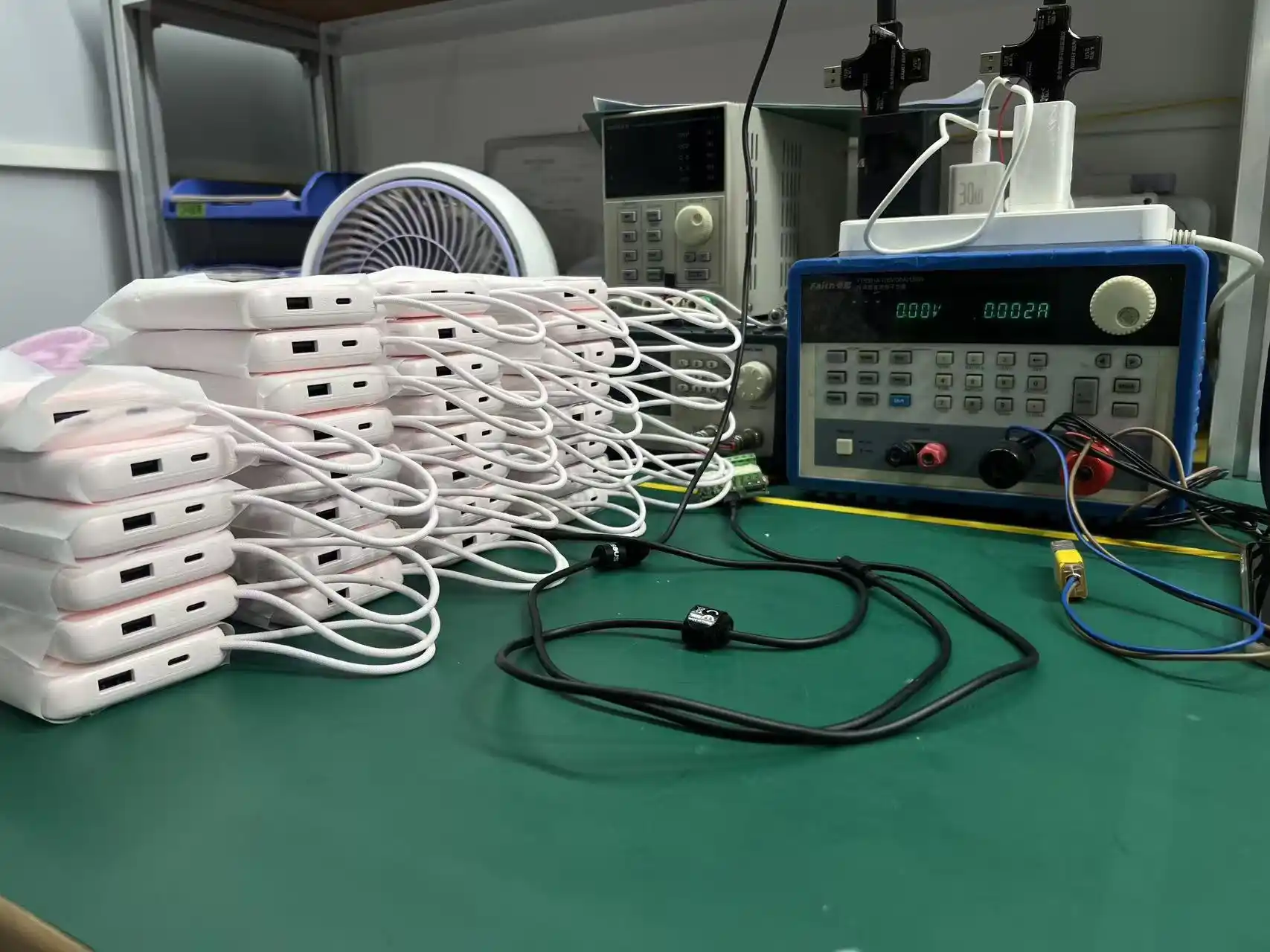
AQL 0.65 sampling QC inspection: every production batch undergoes random sample testing for cell capacity, voltage stability, and conversion efficiency, demand these batch reports from your factory before shipment approval
Spec Verification #1: Capacity Scales Near-Linearly: Demand Batch Test Proof
A 20,000mAh bank should deliver approximately 1.8-2× the usable capacity of a 10,000mAh bank from the same production line. Non-linear results indicate inconsistent cell quality or circuit efficiency degradation at higher capacities. OEM QC requirement: request batch test data at both the minimum and maximum capacity tiers, tested per IEC 61960-3:2017 (secondary lithium cell capacity measurement standard) on a Chroma 17011 battery test system or Arbin BT-2000, with 0.2C discharge rate at 25°C ±2°C ambient. Demand certificates from cell manufacturers: LG Energy Solution (M50T, M58T), Samsung SDI (INR21700-50E), Panasonic (NCR18650B), EVE Energy (ICR18650-26V), and BAK Battery (N21700CG), verified via manufacturer hologram and batch QR traceability code per GB 31241-2022 requirements.
Spec Verification #2: mAh ≠ Speed: Verify Both Capacity AND Wattage on the QC Report
mAh measures stored energy (capacity). Wattage measures delivery rate (speed). A supplier's QC report listing mAh without confirming wattage output at each port is incomplete. A 20,000mAh bank outputting only 10W charges devices slower than a 10,000mAh bank at 30W. OEM QC requirement: the final inspection report must list both rated mAh AND measured wattage output per port at 5V, 9V, 15V, and 20V.
Spec Verification #3: Charge Count Claims Require Conservative Math: Audit Your Supplier's Numbers
The formula every OEM buyer must verify: (Rated mAh × 0.65) ÷ target phone mAh = realistic charge count. A 10,000mAh bank charging a 5,000mAh phone delivers ~1.3 charges at 65% efficiency, not 2.0. To deliver 2 full charges, you need a ~15,400mAh cell. OEM QC requirement: demand your factory calculate charge-cycle estimates using 65% efficiency (the industry-standard conservative baseline) and print that number on retail packaging to preempt capacity-related returns.
More resources: Now that you understand mAh and cell quality verification, read our Power Bank OEM Manufacturer: Custom & Wholesale Sourcing Guide for capacity tier strategy, FOB pricing, and OEM product line planning, or explore Power Bank Specs for OEM Importers for a technical deep-explore charging protocols and certification requirements.
WOWOHCOOL FACTORY STAT
WOWOHCOOL sources Grade-A lithium-polymer cells exclusively from Samsung SDI, LG Energy Solution, and ATL, with the same cell verification standard applied across our Qi2 magnetic power bank and standard OEM lines, verified by batch-level certification and random-sample teardown inspection. Every power bank cell is tested at 5V/2A USB output (not just 3.7V cell voltage) to confirm usable capacity before assembly. GaN-based circuits achieve measured conversion efficiency of 88-92% on Chroma 63600 load testers, verified per production lot. Reject threshold: any cell delivering below 85% of rated usable capacity at 5V output. View our power bank catalog →
Frequently Asked Questions
Cell mAh vs USB output mAh, OEM packaging rules for Amazon FBA compliance?
The advertised mAh is measured at the internal battery cell's 3.7V, but USB output requires 5V minimum. The voltage boost inherently loses energy. Formula: Usable mAh = (Rated mAh × 3.7V × Efficiency) ÷ 5V. At 85% efficiency (GaN-based circuit), a 10,000mAh cell delivers ~6,290mAh usable. At 65% efficiency (budget circuit), the same cell delivers only ~4,800mAh, a 24% real-world difference. Additional losses from cable resistance (5-10%), fast-charging protocol overhead (1-2%), and thermal throttling (5-10% at sustained high load) further reduce end-user delivered capacity. A 10,000mAh bank delivering 6,000-6,500mAh at 5V output is normal, not defective.
How do OEM buyers verify a power bank factory's real capacity is genuine?
Capacity fraud is the #1 supply chain risk in power bank procurement. A-grade cells (Panasonic, Samsung SDI, CATL, ATL): ≤2% label error, ≥80% retention after 500 cycles, <2% return risk. B-grade cells (sorted factory rejects): 5-15% error, 60-75% retention after 200 cycles, 3-8% returns. Three verification steps: (1) Demand a 0.2C discharge test report with cell brand, batch number, and test date. (2) Request conversion efficiency per production lot, GaN achieves 85-92%, budget circuits 60-70%. (3) Test samples with a USB power meter at 5V/2A constant load. Price sanity check: A-grade 10,000mAh GaN runs $6-11/pcs FOB at MOQ 1,000; B-grade at $4-5 signals >30% real capacity gaps.
How many phone charges does each power bank capacity tier actually deliver?
Real-world expectations (85% GaN efficiency, 3,300mAh phone): 5,000mAh = 0.5-0.7 charges (emergency top-up). 10,000mAh = 1-1.5 charges, the gold standard for daily use, highest volume at 47.89% market share. 20,000mAh = 2.5-3 charges, weekend travel, 74Wh within IATA 100Wh limit. 27,000mAh = 3.5-4 charges, 99.9Wh, airline ceiling, requires 65W+ PD output. For wireless/Qi2 magnetic banks: expect 15-20% fewer cycles, a 12,000-15,000mAh magnetic bank matches a wired 10,000mAh. For retail packaging: print conservative estimates using 65% efficiency factor with a formula footnote to preempt the #1 cause of 1-2 star reviews: capacity discrepancy complaints.
mAh vs Wh, which unit should OEM buyers use for procurement and compliance?
Wh is the regulatory standard, IATA, FAA, UN38.3 all use Wh, not mAh. Conversion: Wh = (mAh × 3.7V) ÷ 1,000. Compliance thresholds: ≤100Wh (~27,000mAh) = standard air freight without airline approval. 100-160Wh = airline approval, 2-unit max. >160Wh = prohibited on passenger aircraft. For B2B procurement: always compare products using Wh. If a manufacturer omits the Wh rating, treat it as a red flag. Amazon FBA specifically requires Wh on product detail pages. For retail packaging: Wh must be printed alongside mAh on both the product label and outer carton. WOWOHCOOL includes both as standard.
What cell grade should OEM brands demand from their power battery supplier?
Demand A-grade cells exclusively, the $0.30-0.50/unit savings from B-grade is recovered 10× through reduced warranty returns. A-grade (Samsung SDI, LG, Panasonic, CATL, ATL): ≥98% label accuracy, ≥80% retention after 500 cycles, <2% returns. B-grade: 85-93% accuracy, 60-75% retention after 200 cycles, 3-8% returns. For a 10,000-unit order, B-grade generates 500-800 additional returns. Essential documentation: cell supplier certificates, batch test reports with serial traceability, quality agreement with AQL 1.0 for critical defects. Verify 100% of units undergo capacity testing + 4-hour aging, reject units below 95% of rated capacity.
How does GaN technology improve power bank charging efficiency for OEM products?
GaN (Gallium Nitride) power management ICs achieve 85-92% conversion efficiency vs 60-75% for budget silicon, an 8-25 point gap that directly determines usable capacity. The math: a 10,000mAh cell through 90% GaN delivers ~6,660mAh; through 65% budget delivers ~4,810mAh. That 1,850mAh difference = an extra 0.5 phone charges from the same cell, your customer's real experience. GaN also enables 30% smaller PCB (slimmer products) and generates less heat (longer cell lifespan). For OEM positioning: GaN efficiency is the single largest quality differentiator. Budget $1-3 BOM premium for GaN vs silicon at 30W+, offset by 15-25% retail premium and measurably lower returns.
What is the maximum power bank capacity allowed on airplanes for international shipping?
≤100Wh (~27,000mAh at 3.7V): allowed in carry-on without airline approval, the practical product ceiling for global consumer sales. 100-160Wh: airline approval required, max 2 units per passenger. >160Wh: prohibited on passenger aircraft. Critical for OEM brands: 27,000mAh = 99.9Wh, sitting exactly at the limit. Products labeled above 27,000mAh become restricted items, limiting distribution channels and triggering customer complaints at airport security. For air freight: all lithium battery products require UN38.3 test certification and MSDS documentation. Products must ship at ≤30% charge. DDP shipping from Shenzhen includes all DG declarations.
How do OEM buyers source power banks with verified real capacity from Shenzhen factories?
Step 1: Set your capacity tier, 10,000mAh for volume entry (47.89% market share, FOB $4-7 at 1,000 units), 20,000mAh for premium/travel. Step 2: Demand a 0.2C discharge report and Grade-A cell certification BEFORE deposit, reject any supplier who cannot provide batch-tested data within 48 hours. Step 3: Order 3-5 samples, test with a USB power meter at 5V/2A, compare real output against rated spec. Step 4: Specify conversion efficiency ≥85% in your purchase agreement. Step 5: Require Wh labeling alongside mAh on all products and packaging. WOWOHCOOL provides factory-direct OEM power banks with verified Grade-A cells, GaN efficiency, and complete UN38.3/CE/FCC documentation. Request a quote with serial-traceable capacity test reports.
Supply Chain Expert · Wireless Charging Specialist
Nina Nico is a supply chain management expert with 10+ years experience helping global B2B clients source quality power banks from WOWOHCOOL, a premium charging solution specialist in Shenzhen, China. She holds a degree in International Trade and is a certified supply chain professional (CSCP).
Factory Footprint
ISO 9001 Facility
Shenzhen, China
Export Countries
Engineers In-House
Sourcing Power Banks with Accurate Capacity Specs?
WOWOHCOOL publishes both rated and tested usable capacity for every model. Factory-direct OEM/ODM with MOQ from 500 units, including full custom branding and Amazon FBA-compliant packaging.