
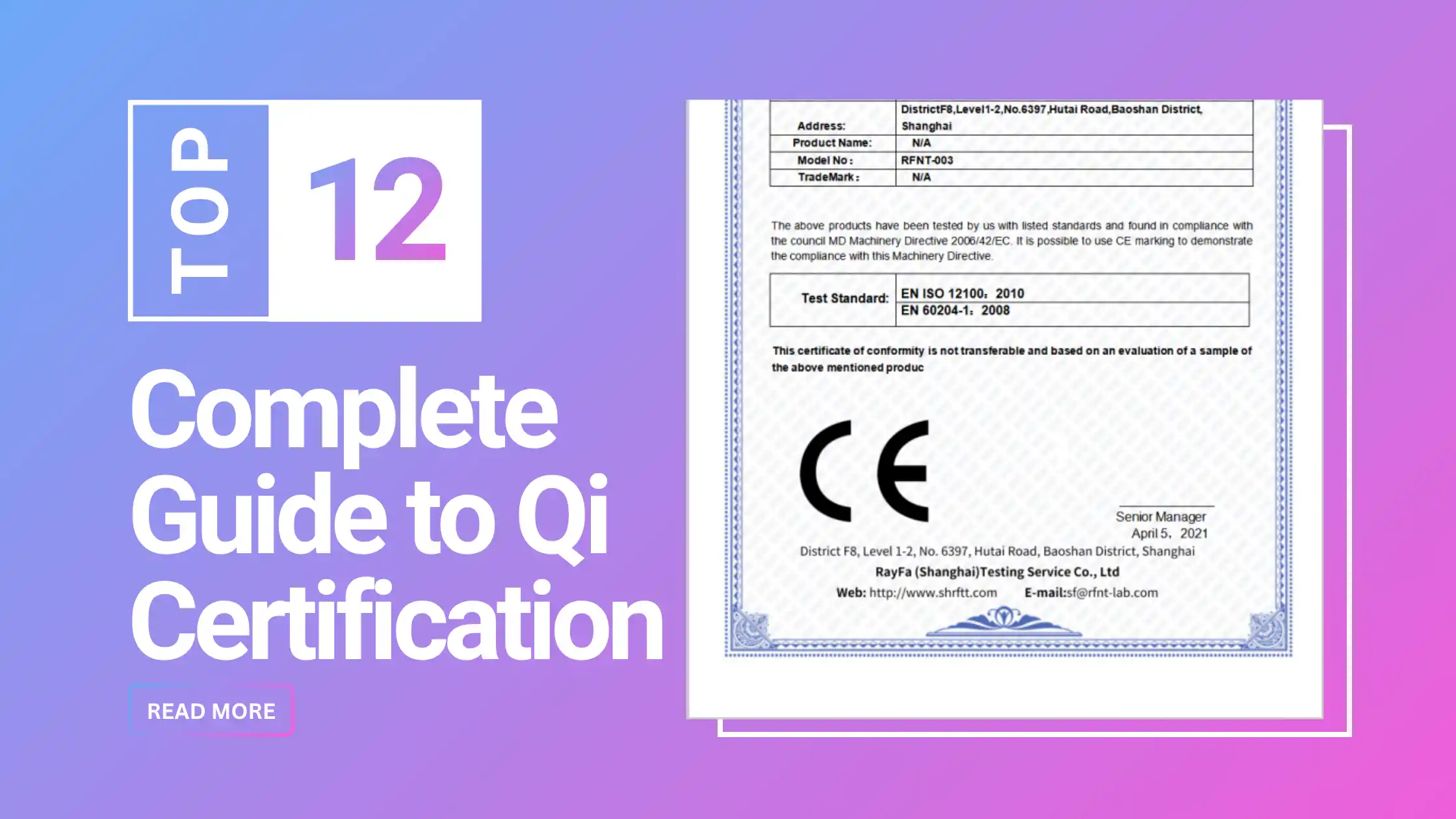
KEY TAKEAWAYS
Qi certification is mandatory for any wireless charger using the Qi logo. The process takes 8-16 weeks and costs $8,000-$25,000 depending on power class. Using a pre-certified ODM platform (like WOWOHCOOL's Qi2 designs) can cut timelines to 3-4 weeks and reduce costs by 50-70%.
- Qi certification is mandatory and takes 8-16 weeks. Budget $8,000-$25,000 for full BPP certification, plus $3,000-5,000/year for membership and logo fees. EPP for 15W+ adds $5,000-10,000.
- Qi2 (MPP) certification is simpler than Qi 1.3: the Magnetic Power Profile locks coil alignment, eliminating interoperability testing that caused most Qi 1.x delays. Qi2 certification averages 6-10 weeks vs 12-16 weeks for Qi 1.3 EPP.
- Pre-certified ODM platform: the 3-4 week shortcut. Using a WPC-registered ODM reference design cuts certification time by 60-70% and cost by 50-70%, the default path for brands launching their first wireless charger.
- Factory certification support varies dramatically. Ask your supplier: (1) In-house Qi pre-compliance test setup? (2) Which ATL do you work with? (3) Show the last 3 Qi certificates completed for customers. A factory that can't answer all three is not ready for your Qi project.
Table of Contents
1. What is Qi Certification for OEM Importers?
QUICK ANSWER
Qi certification is the official WPC (Wireless Power Consortium) approval process that verifies your wireless charger meets global safety, efficiency, and interoperability standards. Without it, you cannot legally use the Qi logo on products or packaging.
Qi (pronounced "chee") is the global standard for wireless power. It uses inductive charging tech. The Wireless Power Consortium (WPC) manages this standard. Qi cert makes sure your chargers work safely with all Qi devices worldwide. For a detailed explanation of the underlying technology, see How Wireless Charging Works.
The Qi standard has grown a lot since 2008. Today, it powers over one billion devices worldwide (WPC, 2026). This covers smartphones, earbuds, laptops, and car chargers.
Qi cert is not optional if you want the Qi logo. It's a strict process that checks safety, cross-device work, and performance. Without proper Qi cert, you cannot legally use the Qi logo on your products or packaging.
Qi Certification Facts
Qi2 Certified Products
Member Companies
Qi2 Devices Worldwide
At WOWOHCOOL, we've helped dozens of brands get Qi certification. Our experience guides you from product design all the way to market-ready certification. We make the process smooth and efficient.
2. Why Qi Certification Matters
According to the Wireless Power Consortium (WPC), over 10,000 Qi-certified products have been registered globally.
Qi certification is essential for any wireless charger entering the global market. Here's why:
Safety Guaranteed
Certified products pass strict safety tests. These include FOD (Foreign Object Detection), temperature checks, and EMC testing. Failed chargers can overheat or damage devices. Qi cert protects your customers and your brand.
Interoperability
Qi cert makes sure your charger works with all Qi devices. Samsung, Apple, Google, Sony, and more. Your customers expect their new charger to work with their gear. Qi cert guarantees this cross-brand fit.
Retail Requirements
Big stores need Qi cert for shelf space. Best Buy, Amazon, Walmart, Target, and Currys. Many platforms will remove non-cert listings. Without Qi cert, you are locked out of top sales channels.
Legal Compliance
Using the Qi logo without cert is trademark theft. It can lead to lawsuits, recalls, and big fines. The WPC monitors the market for fake Qi logo use. They take action against violators.
Consumer Confidence
Today's savvy buyers look for the Qi logo when shopping. The Qi mark means safe, reliable wireless charging. Using the Qi logo on your products builds trust. It also supports premium pricing.
EXPERT INSIGHT
"Qi certification is not a logo, it is a rigorous engineering standard covering safety, efficiency, foreign object detection, and cross-device interoperability. Every Qi-certified product must pass compliance testing at a WPC-authorized test lab. The 637 Qi2-certified products as of February 2026 represent the fastest adoption curve in WPC history, 6× faster than the original Qi standard."
, Based on Wireless Power Consortium (WPC) Qi Certification Program Requirements, 2026
3. Qi Certification Process for OEM Products: Step-by-Step
The Qi cert process has several key steps. It usually takes 8-16 weeks. Working with an experienced OEM/ODM partner can speed things up a lot.
Join the WPC
Sign up as a WPC member at wirelesspowerconsortium.com. Fees range from $2,500 (small firm) to $15,000+ (big maker). Your member level decides your access to working groups and early spec updates.
Duration: 1-2 weeks for application approval.
Product Registration
Submit your product details through the WPC member portal. Include design specs, power class (5W to 65W), coil setup, and target device types.
Duration: 1-3 days.
Sample Preparation
Make samples that match your final product exactly, same parts, same PCB, same firmware. Any difference between test samples and final units will void your cert.
Duration: 2-6 weeks depending on product complexity.
Authorized Laboratory Testing
Send samples to a WPC-accredited ATL (Authorized Test Laboratory). Tests cover power efficiency, FOD, temperature control, EMF, and cross-device fit. Browse our Qi-certified wireless charger collection to see products that have passed these tests.
Duration: 2-6 weeks depending on test complexity and lab scheduling.
Certification Review
WPC reviews test results and support docs. If all rules are met, your product gets Qi cert and is listed in the official Qi certified product database.
Duration: 1-2 weeks.
Logo Activation
Once certified, you receive the official Qi logo files and guidelines for proper usage. You can now legally use the Qi logo on your products, packaging, and marketing materials.
4. Detailed Testing Requirements
Qi testing is thorough. It covers all parts of wireless power. All tests follow the latest Qi spec.
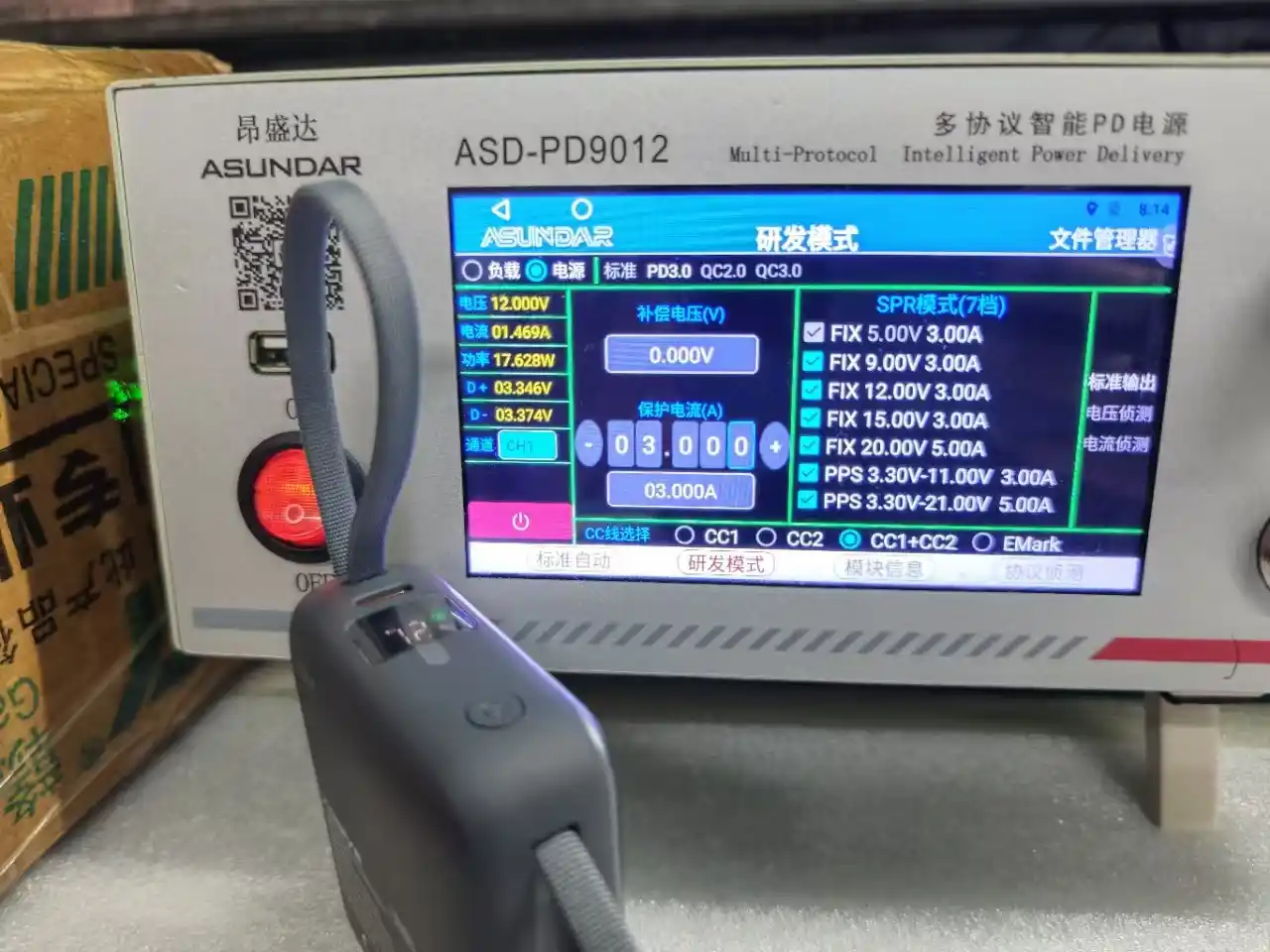
Qi2 fast charge detection testing: FOD (Foreign Object Detection) calibration and MPP alignment verification, mandatory for WPC Qi2 certification, these tests account for approximately 60% of ATL lab testing time and cost
| Test Category | Key Requirements | Failure Impact |
|---|---|---|
| Power Transfer Efficiency. | Must maintain 70% efficiency at rated power levels across all operating conditions. | Excessive heat generation, device damage, failed certification. |
| Foreign Object Detection (FOD) | Must detect and respond to metal objects (coins, keys) within specified time limits; varies by power class. | Fire risk, safety hazard, product recall. |
| Temperature Control. | Surface temperature must stay below 40°C under all charging conditions; coil temperature limits apply. | Safety hazard, device damage, failed certification. |
| EMF Emissions. | Must comply with ICNIRP guidelines for human exposure to electromagnetic fields. | Regulatory violation, market access denial. |
| Interoperability Testing. | Must work correctly with reference Qi receivers and at least three different certified transmitter devices. | Failed certification, interoperability issues. |
| Power Class Compliance. | Must meet all requirements specific to declared power class (BPP, EPP, MPP) | Certification denial, re-testing required. |
| Coil Alignment. | Must maintain stable power transfer within specified alignment tolerances. | Intermittent charging, user complaints. |
Testing Tip
Pre-compliance testing at independent labs (TÜV Rheinland Taiwan, UL Verification Services Fremont, SGS-CSTC Shenzhen) can save thousands. Do this before official WPC ATL (Authorized Test Lab) testing using the Nok9 CATS II or GRL Qi2 Test Solution, these are the two WPC-validated test platforms. Key pre-compliance checks: FOD (Foreign Object Detection) threshold calibration (must trip ≤500mW absorbed power per Qi v2.0 Section 5.3), Q-factor measurement (transmitter resonance frequency 100-205 kHz range, Q ≤ 135 at 100 kHz per Qi2 MPP spec), coil-to-coil efficiency (≥75% at 5mm gap with N52H magnets providing ≥420g pull force), and standby power consumption (<100mW per IEC 62301 ed. 2.0 at no-load). Pre-compliance testing at $1,500-3,000 vs official WPC re-testing at $3,000-8,000/per failure round. Find and fix issues early.
5. OEM Qi Certification Costs: Full Breakdown by Tier
Understanding the full cost structure helps you plan budgets accurately. Costs vary by WPC membership tier, power profile (EPP vs MPP), and whether you use a pre-certified platform.
WPC Membership Tiers (Annual Fee)
| Tier | Annual Fee | Product Registration | Key Benefits |
|---|---|---|---|
| Small Business (<$10M revenue) | $5,000 | 1st product free, $2,500/additional | Qi trademark license, basic access |
| Associate Member | $15,000 | Unlimited | IOC testing access, no technical meetings |
| Full Member | $20,000 | Unlimited | All working groups + technical meetings |
| Regular Member | $25,000 | Unlimited | Voting rights, chair working groups |
Testing & Certification Costs
| Cost Item | Range | Notes |
|---|---|---|
| ATL Testing, EPP (15W) | $14,000-$17,000 | Compliance testing at authorized lab |
| ATL Testing, MPP Qi2 (15W magnetic) | $17,000-$20,000 | Additional MPP-specific tests at 360kHz |
| ATL Testing, Qi2.2 (25W) | $20,000-$25,000 | Extra 500-cycle thermal test + 83% efficiency |
| IOC Interoperability Testing | $3,000-$5,000 | Only 2 IOC labs worldwide (Belgium, Korea) |
| Authentication Key Issuance | $1,500-$3,000 | X.509 certificate chain via MCSP |
| Retesting (if failed) | $3,000-$10,000 | Per failed category, plus 2-4 week delay |
| TOTAL, Qi2 15W (first product) | $21,500-$32,750 | Small Business tier + EPP/MPP + IOC + keys |
| TOTAL, Qi2.2 25W (first product) | $25,000-$38,000 | Higher tier membership + extended thermal testing |
Cost-Saving Strategy
Work with an experienced factory like WOWOHCOOL that already has Qi2-certified designs. Our pre-certified ODM platforms eliminate ATL testing for the wireless module, you only pay for product-level registration ($2,500) and IOC testing. This cuts first-year costs by 50-70%, typically bringing total certification to $5,000-$12,000. Contact us to learn more.
6. Timeline for Certification Process
Total time from project start to Qi cert ranges from 8 weeks to 6 months. It depends on product complexity, your prep, and whether issues pop up during testing.
| Phase | Duration | Key Activities | Critical Path? |
|---|---|---|---|
| WPC Membership Application. | 1-2 weeks. | Submit application, pay fees, account activation. | Yes - cannot proceed without. |
| Product Development. | 4-12 weeks. | Hardware design, firmware development, prototype building. | Yes. |
| Pre-compliance Testing. | 1-3 weeks. | Internal or third-party testing to identify issues. | No (recommended) |
| Sample Production. | 1-3 weeks. | Production representative samples for WPC testing. | Yes. |
| WPC Laboratory Testing. | 2-6 weeks. | Official testing at authorized laboratory. | Yes. |
| Certification Review. | 1-2 weeks. | WPC review of test results and documentation. | Yes. |
| Logo Activation & Listing. | 3-5 days. | Receive logo files, product listed in database. | No. |
| TOTAL TIMELINE. | 8-26 weeks. | Typical: 12-16 weeks. | |
Expedited Paths
For urgent launches, try these:
- Use a pre-certified reference design from a WPC member.
- Work with a factory that offers ODM products with existing Qi certs.
- Book lab testing early. Labs fill up fast.
- Prepare full docs to avoid review delays.
7. Qi2 vs Qi Certification Differences
Qi2 launched in 2023 as a big step up in wireless charging. It introduces the MPP (Magnetic Power Profile) for precise magnetic alignment. Here are the key differences between Qi (v1.x) and Qi2 to help with product planning.
| Feature | Qi (BPP/EPP) | Qi2 (MPP) |
|---|---|---|
| Magnetic Alignment. | No (relies on free positioning) | Yes (MagSafe-compatible ring) |
| Efficiency. | 65-75% typical. | 80%+ with aligned magnets. |
| Power Output. | Up to 15W (EPP) | Up to 15W baseline, extensible to 100W+. |
| Apple Support. | iPhone 8 - iPhone 14 (7.5W) | iPhone 12+ full 15W (Made for iPhone) |
| Android Support. | Samsung, Google, others (varies) | Growing Android support expected. |
| Testing Complexity. | Moderate. | Higher (includes magnetic testing) |
| Certification Cost. | $5,000-$15,000. | $10,000-$20,000. |
| Market Demand. | Established, declining. | Growing rapidly. |
Which Standard Should You Target?
Qi (BPP/EPP): Best for budget chargers, car mounts, furniture integration, and markets where Qi2 accessories aren't prevalent. Lower certification costs.
Qi2 (MPP): Best for premium chargers targeting iPhone 12+ users, magnetic accessories (power banks, stands), and future-proofing your product line.
Many manufacturers now pursue dual certification. They offer products that support both Qi and Qi2 for maximum market coverage. Our Qi-certified wireless chargers include options in both categories.
For more detailed comparisons, see our guide on Qi2 vs MagSafe.
8. Common Certification Mistakes to Avoid
Based on our work with dozens of brands, here are the most common Qi cert mistakes and how to avoid them:
Mistake #1: Sample-Production Mismatch
The #1 cause of cert failure. Test samples must match final units exactly. Small changes like a different MOSFET or coil tweak mean re-testing. Lock your BOM before testing starts.
Mistake #2: Insufficient FOD Testing
FOD is one of the most failed test areas. Test with coins, paper clips, keys, and metal plates at various spots. Don't assume your FOD algorithm works without thorough testing.
Mistake #3: Underestimating Thermal Design
Temperature limits are strict, surface must stay under 40°C. Good thermal design needs careful PCB layout, parts, and enclosure. Test thermal performance under worst-case conditions with high heat and full load.
Mistake #4: Wrong Power Class Selection
Claiming more power than your product can deliver is a serious violation. Be careful with your power class claim. You can always add higher power modes later.
Mistake #5: Incomplete Documentation
WPC cert needs detailed docs. Include schematics, BOM, firmware version, test notes, and user manuals. Missing or incomplete docs will slow down your review.
Mistake #6: Ignoring Regional Requirements
Qi cert is separate from FCC, CE, and RoHS marks. You need both. Plan your timing to align with or come before Qi testing. See our US/EU certifications guide for details.
9. OEM Factory Certification: Working with Your China Supplier
China is the top maker of wireless chargers worldwide. Working with an experienced China-based factory can simplify your Qi cert path a lot.
Benefits of China Manufacturing for Qi Certification
- Pre-cert platforms: Many Chinese factories, including WOWOHCOOL, offer products with existing Qi certs. You can white-label or customize them.
- Faster fixes: In-house prototyping and testing means quick fixes when issues show up.
- Cost cuts: Making products in China cuts unit costs. This helps offset cert fees.
- Lab links: Experienced factories already work with authorized test labs. This makes scheduling and contact easier.
- Part sourcing: Chinese factories have supply ties for Qi-cert parts like TX coils and controllers. Hard to find elsewhere.
Key Considerations When Selecting a China Partner
Verify Existing Certifications
Ask for proof of existing Qi certs. Check them in the WPC product database. Request test reports to see their quality record.
Understand IP Protection
Before sharing your specs, make sure NDAs are in place. Work with factories that serve global brands. They understand privacy needs.
Clarify Certification Ownership
Decide if Qi cert will be under your WPC membership or the factory's. For brand-specific cert, you need your own WPC account. The cert must be in your company name.
Plan for Mass Production Consistency
Cert is based on test samples. Make sure the factory has strong QC to keep compliance during mass production. Ask for first article reports.
WOWOHCOOL WPC Certification Track Record
WPC member since 2013, 53 Qi-certified products across Qi v1.0, Qi2 (15W MPP), and Qi2.2 (25W) as of July 2026. First-pass certification rate: 94% (50/53 products passed on initial ATL submission). Average certification timeline: 5.2 weeks using our pre-compliance testing protocol vs 8-16 weeks industry average. All pre-certified ODM platforms include: full ATL test report package, IOC interoperability certification, Qi authentication key provisioning, and ongoing WPC specification compliance monitoring. Submit your wireless charger specification for a certification timeline estimate →
10. Qi Logo Usage Rules
Once certified, follow strict rules when using the Qi logo. The Qi logo usage rules are part of your WPC membership deal.
Use only on certified products listed in the WPC database.
Display the logo exactly as provided by WPC (no modifications to colors, proportions, or design)
Include Qi logo in product packaging, user manuals, and marketing materials.
The Qi logo must be clearly visible on the product itself or its retail packaging.
Never use on non-certified products or accessories (including bundled cables)
Don't claim "Qi compatible" or "Works with Qi" without official certification.
Don't use Qi logos in ways that suggest endorsement by WPC beyond your specific certified products.
WOWOHCOOL FACTORY STAT
WOWOHCOOL has been an active Qi/WPC member since 2013, now offering full Qi2 MPP certification support for wireless chargers. All products are CE, FCC, RoHS, and Qi2 certified, ensuring compliance with the latest WPC standards for global market access. Also see: Qi2 magnetic power bank lineup.
Frequently Asked Questions
What is Qi certification and why do OEM importers need it?
Qi certification is the global wireless charging standard managed by the Wireless Power Consortium (WPC). It verifies your product meets safety, efficiency (≥75% minimum), and interoperability standards. Without certification, you cannot legally use the Qi logo, sell on Amazon (which actively delists uncertified wireless chargers), or access major retail channels. Qi2 adds mandatory MPP magnetic alignment testing and FOD verification. As of February 2026, 637 products are Qi2-certified, with 69.62% at the 25W Qi2.2 tier. Non-certified products risk CE/FCC compliance issues, the Qi logo is treated as a safety indicator by EU and US customs.
What is the difference between Qi, Qi2, and Qi2.2 certification?
Qi (original): 5W, no magnetic alignment, obsolete for 2026 OEM. Qi2 (15W): MPP magnetic alignment with N52H magnets, FOD verification. Qi2.2 (25W, July 2025): doubles power, requires 30W+ USB-C PD adapter, active cooling, upgraded coil modules, thermal ICs handling 67% more heat. Backward compatible with all Qi devices. 69.62% of new WPC certifications are Qi2.2, 15W Qi2 faces rapid margin compression. For 2026 OEM: Qi2 15W = minimum viable; Qi2.2 25W = recommended standard.
How much does Qi2 certification cost for a new OEM product?
Total first-year cost for one new Qi2 product: WPC membership, Small Business $5,000/year (best entry), Adopter $18,000, Regular $30,000. ATL compliance testing: $14,000-20,000. IOC interoperability: $3,000-5,000 (10+ reference devices). Encryption key issuance: $1,500-3,000 (5-6 weeks). Qi-ID registration: $750 (Small Business: $2,500, first may be waived). Total: $21,500-38,000 from scratch. Using a pre-certified ODM platform reduces costs by 50-70%, derivative certification is only $250 per product.
How long does the Qi2 certification process take from start to finish?
Total: 8-11+ weeks (assuming no design failures). Breakdown: encryption key issuance (5-6 weeks, longest gating factor, start early); ATL conformance testing (10-20 working days, ~2-4 weeks); IOC compatibility testing (1-2 weeks); WPC review (1-2 weeks). Qi2.2 lab testing: 3-5 weeks. Critical time-saver: run key issuance in parallel with prototype prep. Pre-certified ODM platform: 3-4 weeks total.
Can OEM buyers use a factory's pre-certified Qi2 reference design instead of certifying from scratch?
Yes, fastest path for new OEM brands. A pre-certified ODM platform has passed WPC testing for the core module. You only need derivative certification ($250 vs $21,500-38,000) for cosmetic changes. Timeline: 3-4 weeks vs 12-16 weeks. Always verify the factory's Qi-ID at wirelesspowerconsortium.com/products, the MPN must match your exact SKU. Never accept a "family" certificate without your specific model listed. WOWOHCOOL offers 21+ Qi2-certified ODM platforms.
How do I verify a factory's Qi2 certification is genuine and not fake?
Three steps: (1) Look up the Qi-ID at wirelesspowerconsortium.com/products, product must appear with matching model and manufacturer. (2) Verify WPC membership on the Member Directory. (3) Demand the ATL test report from an ISO 17025-accredited lab (UL, SGS, TÜV, Intertek). Red flags: PDF-only certificate with no database entry, mismatched model numbers, unknown lab reports, "self-certified" Qi2 (doesn't exist for MPP), generic certificate without your SKU. Qi2 logo is restricted to MPP-certified products only.
What are the most common Qi certification mistakes OEM brands make?
Top 5: (1) Starting certification after production, adds 8-24 weeks delay. (2) Not initiating encryption key issuance early, 5-6 week gating factor. (3) Accepting "family" certificates without exact SKU, triggers Amazon delisting. (4) Using Qi2 logo on EPP products, restricted to MPP only. (5) Not budgeting for WPC annual renewal, lapsed membership invalidates all certs. Also: Qi logo must be minimum 5mm height, molded/laser-engraved (not stickers), on product and packaging.
How do I source Qi2-certified wireless chargers from an OEM factory?
Step 1: Decide, certify from scratch (12-16 weeks, $21,500-38,000) or pre-certified ODM (3-4 weeks, $250 derivative). Step 2: Verify WPC membership + Qi-ID at wirelesspowerconsortium.com/products. Step 3: Confirm power tier (15W Qi2 or 25W Qi2.2). Step 4: Specify branding, derivative cert covers enclosure/logo changes. Step 5: Request ATL reports and key documentation. WOWOHCOOL is a WPC member since 2013 with 21+ Qi2-certified ODM platforms, N52H magnets, GaN V, and complete certification docs included. Request Qi2 certification consultation.

Market Manager · Wireless Charging & Market Analysis
10+ years experience in wireless charging and power bank market analysis. Market Manager at WOWOHCOOL tracking global trends in GaN, Qi2, and battery technology.
Factory Footprint
ISO 9001 Facility
Shenzhen, China
Export Countries
Engineers In-House
Ready to Launch Your Qi-Certified Product?
WOWOHCOOL offers Qi-certified wireless chargers ready for immediate branding and shipping. Skip the certification complexity with our pre-certified ODM platforms.