
OEM Shipping from China 2026: Freight, Customs & Landed Cost Guide

Global Procurement & Sourcing Manager · 10+ years in 3C procurement & sourcing
Choosing the wrong Incoterm on your first China purchase order can add 15-30% to your landed cost, before a single unit ships. For OEM buyers importing chargers and power banks, the shipping decision (FOB vs DDP, sea vs air, LCL vs FCL) directly determines your per-unit margin. This guide covers Incoterms, freight modes, customs documentation, and landed cost calculation, with 2026 duty rates and transit times from Shenzhen.
Key Takeaways
DDP is the recommended Incoterm for first-time OEM importers: FCL 20GP runs $2,000-2,800 Shenzhen to US West Coast (25-32 days), and clearance needs 4 documents (Commercial Invoice, Packing List, B/L or AWB, CE/FCC/UN38.3 docs).
- Sea freight (FCL 20GP via COSCO/MSC/Maersk): $2,000-2,800 Shenzhen (Yantian/Shekou) → US West Coast (LA/LB) 25-35 days. EU: Yantian → Rotterdam (Maersk AE10 service, 28-32 days) or Hamburg (Hapag-Lloyd, 30-35 days). Air freight (Cargolux/Korean Air Cargo via SZX/PVG): ~$7/kg, 5-10 days. Express (DHL/UPS/FedEx): $8-15/kg, 3-7 days. All prices 2026 spot, subject to BAF/CAF adjustment per Shanghai Containerized Freight Index (SCFI).
- DDP (Delivered Duty Paid) is the recommended Incoterm for first-time OEM importers: the factory handles freight, insurance, customs clearance, and duty payment to your door. DDP premium: 8-15% above FOB+freight. FOB is cheaper per unit but shifts customs risk to you, only use FOB after 3+ successful shipments.
- Landed cost = Product FOB + Freight + Insurance + Customs Duty (+ Tariffs). For charger imports to the US, duty is typically 0-3.4% under HTS 8504.40. Add 25% Section 301 tariff if applicable. Always calculate landed cost before comparing supplier quotes, a $0.50/unit cheaper factory can cost $1.20/unit more after shipping.
- Customs clearance requires 4 documents: Commercial Invoice, Packing List, Bill of Lading (sea) or Air Waybill (air), and Certificate of Origin. For chargers, also prepare CE/FCC/UL certificates and the factory's ISO 9001 registration, missing docs are the #1 cause of customs holds.
- Freight forwarder selection: ask your factory for 3 quotes from different forwarders. Verify the forwarder has a physical office at your destination port. Prefer forwarders who specialize in electronics, they handle lithium battery declarations (UN38.3, MSDS) without delays.
Table of Contents
1. Why Does Shipping Matter for OEM Charger Imports?
Direct answer: shipping is a landed-cost control, not just freight; sea, air, rail and express differ in cost, transit time and dangerous-goods handling.
Shipping costs can account for 5-30% of your total product cost when importing from China. Miscalculating these costs is one of the most common mistakes new importers make, and two 2025-2026 regulatory changes made the math harder. First, the $800 Section 321 de minimis exemption ended for China origin on May 2, 2025: every parcel now pays full duty or a $200 flat postal duty, making DDP the default. Second, IATA DGR 67th requires lithium battery state of charge ≤30% for all UN3481 shipments from January 2026, with valid UN38.3 test reports mandatory for every power bank.
At WOWOHCOOL, we've helped over 500 brands navigate the complexities of importing from China since 2013. Our logistics team coordinates daily with freight forwarders across all major shipping routes, ensuring competitive rates and reliable delivery schedules for wireless chargers and all our products.
Shipping Cost Impact
- Shipping averages 8-15% of total landed cost for standard orders.
- Air freight can add $0.50-2.00 per unit versus sea freight.
- Express shipping (DHL, FedEx, UPS) adds $2-5 per unit for small orders.
- Dimensional weight pricing can double shipping costs for light products.
- The end of the $800 de minimis means every parcel now carries the full duty stack: MFN rate plus up to 25% Section 301 on HTS 8504 chargers.
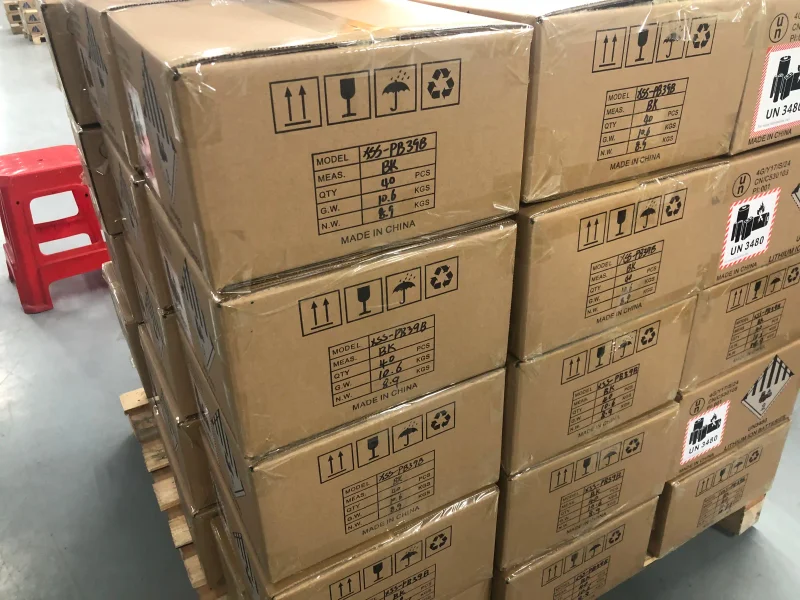
Products packaged and ready for international shipping from Shenzhen factory
2. What Are Incoterms and Why Do They Matter?
Direct answer: Incoterms are the rules that decide where risk and cost transfer; FOB means the buyer controls freight after Shenzhen port, while DDP means the seller delivers duty-paid.
Incoterms (International Commercial Terms) define who is responsible for what during the shipping process. Published by the International Chamber of Commerce (ICC), the Incoterms 2020 rules are the globally recognized standard for allocating shipping cost and risk. Understanding these terms is essential for accurate cost calculation and risk management.
| Incoterm | Name | Risk Transfer | Best For |
|---|---|---|---|
| EXW | Ex Works | Seller's premises | Experienced importers with own logistics |
| FOB | Free on Board | Port of loading | Most common for sea freight |
| CIF | Cost Insurance Freight | Port of loading | Buyer wants insurance included |
| DDP | Delivered Duty Paid | Buyer's premises | Turnkey solution, higher price |
| DAP | Delivered at Place | Named place | Buyer pays duties separately |
Recommended Incoterms for Chargers
FOB Shenzhen / FOB Guangzhou: Most common and recommended for most importers. The seller handles factory preparation and port handling; you arrange main carriage and insurance.
DDP (Delivered Duty Paid): Best for new importers who want a single invoice covering everything. The seller handles all logistics including duties.
EXW: Only recommended if you have established relationships with freight forwarders and can arrange all logistics efficiently.
3. Shipping Options: Sea, Air & Express
Direct answer: sea freight is the lowest-cost option for volume, air freight is the fastest for urgent SKUs, rail is a middle option for Europe, and express is for samples or small parcels.
According to the Freightos Baltic Index (FBX), 2026 spot rates have settled: China to US West Coast averages $2,000-2,800 per 20GP and $2,650-4,100 per 40HC to the East Coast. Air freight to the US sits around $7.00/kg (up 20% YoY), China to Europe air at $4.80/kg (up ~75% YoY). China-Europe rail: $1.80-2.60/kg, 22-28 day transit. Express courier (DHL, FedEx, UPS): $8-15/kg door to door.
Choosing the right shipping method depends on your order volume, urgency, and budget. Here's a detailed comparison:
Sea Freight (20GP / 40GP / 40HC)
Transit Times
- China to US West Coast: 15-25 days fast vessel / 30-40 days slow vessel
- China to US East Coast: 25-35 days (Panama Canal routing)
- China to Europe: 25-35 days (Suez or Cape of Good Hope)
- China to Australia: 15-25 days
Container Capacities
- 20GP: ~25-28 CBM (ideal for 2,000-3,000 chargers)
- 40GP: ~55-58 CBM (ideal for 4,000-6,000 chargers)
- 40HC: ~65-68 CBM (ideal for 5,000-8,000 chargers)
Estimated Costs (2026 spot rates)
- China to US West Coast: $2,000-2,800 (20GP), $2,650-3,400 (40HC)
- China to US East Coast: $2,800-4,100 (40HC, includes Panama surcharge)
- China to Europe: $1,500-3,100 (20GP), $2,500-3,400 (40HC)
- BAF (Bunker Adjustment): $200-800 per container
- CAF (Currency Adjustment): 5-15% of freight rate
Source: Freightos Baltic Index and Dantful 2026 rate trackers. Spot rates fluctuate with blank sailings, peak season, and fuel costs.
Air Freight
Transit Times
- China to US: 5-7 days
- China to Europe: 4-6 days
- China to Australia: 3-5 days
Charges
- Chargeable weight: max of actual versus dimensional
- Dimensional factor: L×W×H (cm) ÷ 6000
- Minimum charge: often applies
- UN3481 lithium goods: SOC must be ≤30%
Estimated Costs (2026)
- China to US general rate: ~$7.00 per kg (up roughly 20% year on year)
- China to Europe general rate: ~$4.80 per kg (up roughly 75% year on year)
- Minimum chargeable: $120-200
- Fuel surcharge: $0.30-0.60 per kg
- Security surcharge: $0.10-0.20 per kg
Example: 500 kg US shipment ≈ $3,500-4,500 air freight, including surcharges.
Source: BSI Freight 2026 air rate monitor.
Express Courier (DHL / FedEx / UPS)
Best for samples, small orders, and urgent shipments. Door-to-door service with customs clearance included. Note: post de minimis, every parcel still pays full duty regardless of declared value.
Estimated Costs (2026)
- Per kg rate: $8-15 (zone dependent)
- Minimum shipment: 0.5-1 kg
- Fuel surcharge: 15-20% of base rate
- Customs clearance: usually included
Example: 10 kg shipment ≈ $150-250 express.
Best for: samples under 100 kg, urgent reorders, trade show inventory.
Rail Freight (China-Europe Block Train)
An underused middle option for EU customers. China-Europe block trains run from hubs such as Yiwu, Chongqing, and Xi'an to Duisburg, Hamburg, and Madrid. Rail outpaces sea on time and undercuts air on cost.
Transit Times
- Yiwu to Duisburg: 18-22 days
- Chongqing to Hamburg: 20-25 days
- Xi'an to Madrid: 22-28 days
Suitable Cargo
- Mid-volume orders that cannot wait for sea
- EU restocking between FCL batches
- Non-dangerous-goods chargers (lithium batteries face country-by-country rail rules)
Estimated Costs (2026)
- Container rate: $1,500-5,500 per 20GP/40HC depending on corridor
- LCL/groupage: $1.80-2.60 per kg
- Customs and final mile: arranged at EU hub
Source: ddpchain 2026 rail freight monitor. Lithium battery shipments may require pre-approval from corridor operators.
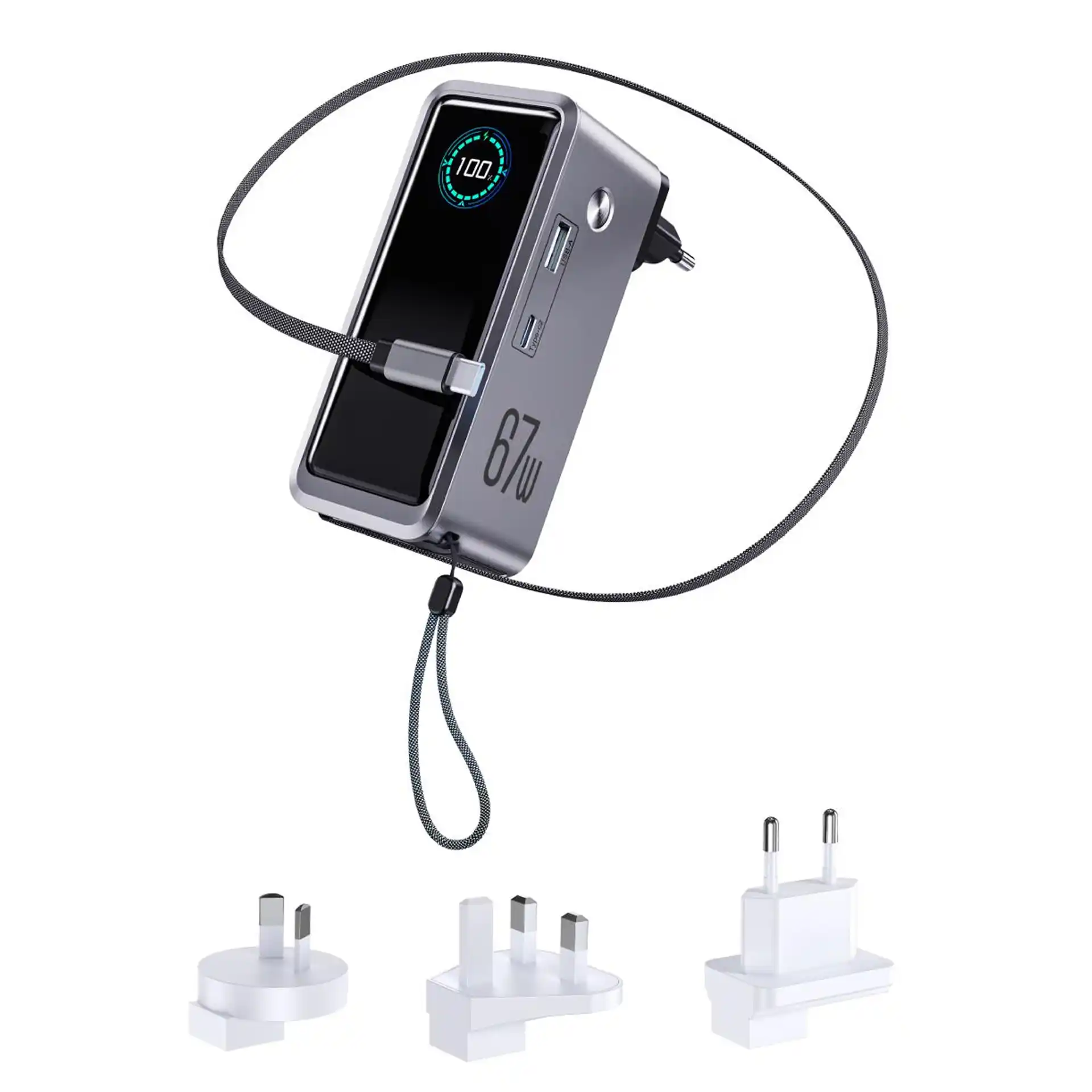
Popular 2-in-1 charger product for export - compact size reduces shipping costs
4. OEM Landed Cost: FOB vs DDP & Total Cost Calculation
Total Landed Cost (TLC) is the complete cost of getting your products to your warehouse, including all fees and duties. Here's how to calculate it:
Landed Cost Formula
TLC = Product Cost + Freight + Insurance + MFN Duty + Section 301 + Port Fees + Last Mile
- Product Cost: FOB price from supplier.
- Freight: sea ($0.05-0.15 per unit) or air ($0.30-0.80 per unit).
- Insurance: typically 0.2-0.5% of cargo value (CIF).
- MFN Duty: HTS code base rate × CIF value (HTS 8504.40.95 wireless chargers: 0% MFN; 8504.40.85 USB and car chargers: 2.5% MFN).
- Section 301: up to 25% surcharge for China origin under HTS 8504 unless an active exclusion applies. Current exclusions are extended to November 10, 2026.
- Port Fees: terminal handling and congestion surcharges.
- Last Mile: trucking to your warehouse or to an Amazon FBA destination.
Example Calculation: 5,000 Wireless Chargers (HTS 8504.40.95)
Key Insight: Section 301 alone now adds 25% to CIF for most China-origin chargers, lifting landed cost roughly 55% above FOB on a 5,000-unit wireless charger order. With the $800 de minimis closed, the same math applies to small parcel and FBA direct shipments. Verify exclusions and apply them with a licensed customs broker before booking.
WOWOHCOOL - professional OEM partner with comprehensive export shipping support
5. Customs Clearance for OEM Importers
Direct answer: customs clearance requires correct HS codes, commercial invoice, packing list, certificate of origin and battery documentation such as UN38.3 and MSDS.
According to the US International Trade Commission (USITC), Section 301 tariffs on Chinese electronics range from 7.5% to 25%, making customs classification and duty planning essential components of any importing strategy.
Customs clearance is often the most confusing part of importing. Understanding the process helps avoid delays and unexpected costs.
2026 Lithium Battery Shipping Update
Power banks and devices with built-in lithium batteries (UN3481, over 2.7 Wh) face stricter shipping rules effective January 1, 2026. The IATA DGR 67th Edition and IMDG Code 42-24 now require:
- SOC ≤30% (state of charge) for both air and sea shipments. Special Provision A331 is the only exception path and requires written approval from both the State of Origin and the State of the Operator.
- Valid UN38.3 test report from a CNAS or CMA accredited lab.
- MSDS must explicitly state SOC ≤30% compliance.
- SOC compliance statement on the shipping documents to avoid airport security rejection.
- Lithium battery mark (100×100 mm) on every outer carton.
- EU Battery Regulation 2023/1542: the EU Battery Passport becomes mandatory on February 18, 2027, but the scope covers EV batteries, light-means-of-transport batteries, and industrial batteries above 2 kWh. Consumer power banks are not in the 2027 scope, although early Digital Product Passport adoption is encouraged.
WOWOHCOOL pre-discharges every power bank to under 30% SOC, issues a SOC compliance statement, and provides UN38.3 test reports plus the lithium battery mark on every export carton.
Required Documentation
- Commercial Invoice: detailed invoice with HS codes, values, and the Incoterm in effect.
- Packing List: contents, quantities, weights, and carton dimensions.
- Bill of Lading (B/L) or Air Waybill (AWB): ocean bill for sea freight, AWB for air.
- Certificate of Origin: required for preferential tariffs (FTA countries) and to evidence China origin for Section 301 calculation.
- Product Specifications: technical details for HS code classification.
- FCC SDoC / FDA Registration: required for radio-frequency electronics and certain medical-adjacent devices entering the US.
- UN38.3 Test Report and SOC Compliance Statement: mandatory for any shipment containing lithium batteries.
HS Codes for Chargers
| Product | HS Code | US Duty | EU Duty |
|---|---|---|---|
| Wireless Chargers | 8504.40.95 | 0% | 2.5% |
| USB Chargers (5V) | 8504.40.85 | 2.5% | 2.5% |
| Fast Chargers (PD) | 8504.40.95 | 0% | 2.5% |
| Car Chargers | 8504.40.85 | 2.5% | 2.5% |
Note: Duties may vary. Always verify current rates with a customs broker.
Common Customs Issues
- Undervaluation: never undervalue goods. With the $800 de minimis suspended, every package is checked against reasonable transaction value and undervaluation triggers seizure plus penalties.
- Wrong HS Code: misclassification results in delays, fines, and retroactive duty adjustments. HTS 8504 has multiple subheadings that fall under different Section 301 rates.
- Missing Documentation: incomplete paperwork extends clearance time by days or weeks.
- Battery DG Errors: missing UN38.3 reports, an MSDS without SOC ≤30% language, or absent lithium battery marks lead to airline rejection or ocean container roll-overs.
Post De Minimis: What Changed for Small Parcel Imports
For decades, US importers used the $800 Section 321 de minimis threshold to bring in small parcels duty-free, an arrangement that handled roughly 4 million packages per day from China. That changed in two steps:
- May 2, 2025: Executive Order 14256 ended the $800 exemption for China and Hong Kong origin goods.
- August 29, 2025: the suspension was extended to all origins, with a February 2026 White House proclamation confirming the suspension continues.
- Today: every parcel from China pays the full duty stack or a $200 flat postal duty, regardless of declared value.
The practical impact for charger importers: small shipment cost advantage has collapsed. FCL sea freight, DDP terms, and Amazon-ready factory prep have become the predictable pricing path. Verify each shipment against the current US Trade Representative exclusion list (extended through November 10, 2026 under the November 2025 US-China understanding).
6. B2B Freight Forwarder Selection: What to Ask Your Factory
Direct answer: the freight forwarder check is whether they can quote a real $2,000-2,800 per 20GP US West Coast rate, name the carrier and route, and confirm customs clearance and dangerous-goods approval in writing; WOWOHCOOL requires those items in writing before release.
A good freight forwarder can save you money and headaches. Here's what to look for:
Essential Criteria
- Licensed by FIATA or similar body
- Experience with electronics/chargers
- China office with English-speaking staff
- Network of reliable carriers
- Transparent pricing (no hidden fees)
- Responsive communication
Questions to Ask
- What are all your fees (including surcharges)?
- How do you handle customs clearance?
- What's your typical transit time guarantee?
- Do you offer cargo insurance?
- How do you handle claims or delays?
- Can you provide references from similar clients?
WOWOHCOOL Tip: We work with vetted freight forwarders who offer competitive rates for our clients. Ask us for recommendations when placing orders.
7. Shipping Tips for Chargers
Direct answer: charger shipments are safer when the carton includes lithium-battery marks, SOC at or below 30%, UN38.3 report, MSDS and a security seal.
Optimize Packaging
Standard retail packaging can be compressed. Individual boxes nested together in cartons maximize container space. For chargers, a 40GP holds approximately 8,000-12,000 units with standard retail packaging.
Consolidate Shipments
If ordering from multiple suppliers, consolidate shipments into one container. LCL (Less than Container Load) consolidation saves money but adds handling time and risk.
Book During Off-Peak
Shipping rates spike during September-November (pre-holiday) and Chinese New Year. Book containers 4-6 weeks in advance during peak season to secure space and rates.
Insure Your Cargo
Marine cargo insurance costs 0.1-0.5% of cargo value and protects against loss, damage, and delays. Standard coverage excludes rough handling and moisture damage, request all-risk coverage for chargers and power banks.
Plan for Port Congestion
Major ports experience delays during peak seasons. Los Angeles/Long Beach currently averages 3-7 days of waiting time. Build this buffer into your inventory planning or consider alternative ports.
Track Your Shipment
Most freight forwarders provide online tracking for sea and air shipments. Request tracking credentials and monitor your shipment's progress. For high-value orders, consider real-time GPS trackers that can be placed inside containers for complete visibility throughout the journey.
Battery Shipping Compliance (UN38.3 + SOC ≤30%)
Power banks and chargers with lithium batteries require UN38.3 certification for both air and sea transport. Under IATA DGR 67th Edition (January 1, 2026), UN3481 cells over 2.7 Wh must ship at no more than 30% state of charge, and a SOC compliance statement must travel with the cargo or the airline will reject it. WOWOHCOOL pre-discharges every power bank, provides UN38.3 reports from CNAS or CMA accredited labs, and includes the MSDS plus lithium battery mark on every export carton.
Amazon FBA from China in 2026: Factory Prep Is Now Mandatory
Amazon discontinued all US FBA prep and labeling services on January 1, 2026. Sellers must arrive at the fulfillment center with FNSKU labels applied, polybags sealed, and bundles assembled, or face rejection, return shipping, and storage fees. This collapses the case for last-mile prep providers and pushes the work back to the factory floor.
What changes for charger sellers:
- FNSKU labels must be printed and applied by the factory before export.
- Polybagging, suffocation warning, and master carton labels follow Amazon SKU-level rules per ASIN.
- DDP-to-FBA shipping (factory direct to Amazon address) becomes the dominant fulfillment model because it bundles customs, duty, and Amazon-specific compliance into a single invoice.
- Three-party paperwork (commercial invoice, packing list, AWB) must show the Amazon address as the consignee.
WOWOHCOOL offers Amazon-ready packaging, in-house FNSKU labeling, and DDP-to-FBA shipping for charger and power bank sellers, with sample turnaround in 3-7 days.
8. Conclusion: Plan Ahead for Success
Direct answer: the conclusion is that the lowest freight quote is not always the lowest landed cost; buyers must compare all-in door cost, risk and transit reliability.
Shipping from China doesn't have to be complicated. Understanding Incoterms, knowing your shipping options, and accurately calculating landed costs are the foundations of successful importing. Whether you are a first-time importer or an experienced procurement manager, having a reliable logistics partner makes all the difference in avoiding costly mistakes and ensuring smooth delivery.
Whether you're importing power chargers, wireless chargers, or car chargers, the principles remain the same: plan ahead, work with reliable partners, and always factor shipping into your pricing.
One often overlooked aspect is documentation readiness. Start gathering shipping documents, commercial invoice, packing list, certificate of origin, and bill of lading, at least two weeks before your cargo is ready. Missing paperwork is the most common cause of customs delays and can add 3-10 days to delivery timelines. WOWOHCOOL provides complete export documentation with every order.
Partnering with a factory that understands international logistics can significantly streamline your importing process. WOWOHCOOL's logistics team coordinates with major freight forwarders across all routes, ensuring competitive rates and reliable delivery schedules. We offer FOB, CIF, and DDP shipping options to match your business needs and experience level.
Contact our team for help calculating shipping costs for your specific order or to discuss our OEM/ODM services including logistics coordination.
"Choosing the right Incoterm and shipping method can save you 15-30% on logistics costs," says Nina Nico, Global Procurement & Sourcing Manager at WOWOHCOOL. "For most first-time importers, FOB Shenzhen strikes the right balance between cost control and simplicity. As your volume grows, you can transition to EXW with your own freight forwarder for better rates."
For a complete breakdown of duties and taxes, see our import costs guide for chargers. Also read about quality control standards to ensure your shipped products meet destination market requirements.
WOWOHCOOL FACTORY STAT
WOWOHCOOL handles 1-2 container loads monthly from Shenzhen (Yantian/Shekou) plus 2-3 air freight and express shipments/month via SZX. Proven transit times (2026 averages): Sea freight LCL to LA/LB: 18-22 days; to Rotterdam: 26-30 days. Air freight to US/EU hubs: 5-8 days door-to-door. Our in-house documentation team pre-files ISF and customs declarations before vessel departure, and DDP shipments typically clear customs within 48 hours. Amazon FBA: FNSKU labeling, carton labeling, and palletization done in-house per Amazon SPD requirements. Request a shipping quote →
Frequently Asked Questions
FOB vs DDP: which Incoterm should importers use for their first order?
DDP (Delivered Duty Paid) is recommended for first-time importers. The factory handles freight, insurance, customs clearance, and duty payment to your door. The DDP premium is 8-15% above FOB+freight, but eliminates 3-5 days of customs uncertainty and potential storage/demurrage fees. Switch to FOB (Free On Board) once you have completed 3+ successful shipments and have a relationship with a customs broker. With the $800 de minimis exemption suspended since 2025, DDP has become the default for predictable landed cost.
How do importers calculate total landed cost for a charger shipment?
Landed Cost = (FOB Unit Price × Quantity) + Freight + Insurance + Customs Duty + Broker Fee + Trucking. Example: 1,000 units of a 65W GaN charger at FOB $5.00/unit = $5,000 product cost. Sea freight ~$400 (LCL) = $0.40/unit. Insurance ~$25. Duty at 3.4% (HTS 8504.40) = $170. Broker fee ~$150. Trucking ~$200. Total landed: ~$5,945, $5.95/unit, 19% above FOB. Always calculate landed cost before comparing supplier quotes, a factory quoting $0.50/unit cheaper can cost $1.20/unit more after shipping.
What documents do importers need for customs clearance?
Four documents are mandatory under 19 CFR § 141.86 (US) and UCC Art. 163 (EU): (1) Commercial Invoice with 10-digit HTSUS/TARIC code, quantity, FOB value, and country of origin declaration, (2) Packing List with carton dimensions (L×W×H in cm), gross/net weight per carton, (3) Bill of Lading (sea, OBL or Sea Waybill per Hague-Visby Rules) or Air Waybill (IATA 600b), (4) Certificate of Origin (Form A for EU GSP, Form F for China, or USMCA certification of origin for Mexico/Canada transshipment). For US ocean shipments: submit ISF-10 (CBP Form 10+2) at least 24 hours before vessel departure, and AMS (Automated Manifest System) filing via SCAC-registered NVOCC. For chargers, also prepare: CE/LVD test report per EN 62368-1, FCC Part 15B SDoC or test report, UL 62368-1 certificate, factory ISO 9001:2015 registration, and UN38.3 test summary (Rev. 7) + MSDS (per GHS Rev. 8) for lithium battery products. Missing documents are the #1 cause of customs holds, a 2-4 week delay at $150-300/day in CBP CES (Centralized Examination Station) or EU temporary storage fees.
What are the dangerous goods rules for shipping lithium battery chargers and power banks?
Power banks and products with built-in lithium batteries are Class 9 Dangerous Goods (UN3480/UN3481). Requirements: UN38.3 test certification (mandatory, included in CE/FCC/RoHS package $2,500-4,500, 4-6 weeks), MSDS documentation, batteries must ship at ≤30% charge state per IATA. ≤100Wh (~27,000mAh): standard DG cargo with proper labeling. 100-160Wh: airline approval, max 2 units/package. >160Wh: prohibited on passenger aircraft. Logistics costs are 25-40% higher than standard electronics due to DG surcharges. Never ship undeclared lithium batteries, fines start at $50,000 per violation.
How do importers plan their first OEM shipment from China to avoid costly delays?
Step 1: Choose Incoterm, DDP for first order (factory handles freight + customs + duty), switch to FOB after 3+ successful shipments. Step 2: Budget 10-12 weeks total: 25-30 days production + 25-35 days sea freight + 3-5 days customs + 2-3 days trucking. Step 3: Prepare documents BEFORE production finishes, Commercial Invoice, Packing List, Bill of Lading, CE/FCC/UL certs, UN38.3/MSDS for batteries. Step 4: Use a lithium-battery-specialist forwarder who files DG declarations without delays. Step 5: Budget landed cost (19% above FOB), not FOB. WOWOHCOOL offers DDP shipping from Shenzhen with all DG declarations and customs clearance included. Request a DDP shipping quote for your first OEM order.
Global Procurement & Sourcing Manager · 10+ years in 3C procurement & sourcing
Nina Nico is WOWOHCOOL's Global Procurement & Sourcing Manager with 10+ years in 3C procurement. She specializes in B2B hardware sourcing, OEM/ODM power bank manufacturing, factory audits, supply chain quality assurance, and international trade compliance.
Factory Footprint
ISO 9001 Facility
Shenzhen, China
Export Countries
Engineers In-House
Ready to Ship from China?
WOWOHCOOL offers FOB, CIF, and DDP shipping options with full documentation support. Get a complete shipping quote including customs clearance within 4 business hours.
Sources & References
- ICC, Incoterms 2020 Rules (International Chamber of Commerce)
- Freightos, International Freight Rate Index & Shipping Guide
- IATA, Dangerous Goods Regulations (DGR)
- IMO, IMDG Code for Maritime Dangerous Goods
- U. S. Customs & Border Protection, Import Guide
- Amazon Seller Central, FBA Shipping & Prep Requirements