
USB-C PD 3.1 Charger OEM: 240W Factory Sourcing Guide

Supply Chain Expert · 10+ years in OEM/ODM Manufacturing
USB PD 3.1 doubles max power from 100W to 240W via EPR (28V/36V/48V), a single USB-C cable now charges everything from earbuds to gaming laptops. The EU mandate requires USB-C for all notebooks from April 2026, making PD 3.1 mandatory for laptop charger OEMs. For B2B buyers: GaN PD 3.1 chargers start at MOQ 500, FOB Shenzhen $8-22/unit. Above 100W, you need both an EPR-rated charger AND EPR e-marker cable, one without the other caps you at 100W.
Key Takeaways
- USB-C PD 3.1 extends power delivery from 100W (PD 3.0) to 240W via EPR (Extended Power Range) at 28V, 36V, and 48V. SPR (Standard Power Range) still covers up to 100W at 20V. For OEM buyers: PD 3.1 EPR is required for 140W+ laptop chargers; PD 3.0 SPR remains sufficient for phones, tablets, and sub-100W laptops.
- EPR cables are physically different from SPR cables. EPR requires a certified E-Marker chip rated for 50V/5A (vs 20V/5A for SPR). Using an SPR cable with a 140W EPR charger limits output to 100W. OEM buyers: specify EPR-rated E-Marker chips (Cypress CYPD2104 or equivalent) in your BOM for any 100W+ charger SKU.
- PD 3.1 + PPS is the 2026 minimum viable spec for multi-port chargers. A 140W PD 3.1 charger with PPS dynamically allocates power across ports (e.g., 100W to laptop + 30W to phone + 10W to earbuds). Without PPS, the charger uses fixed voltage rails and can't optimize per-device, resulting in slower charging and customer complaints about "my charger says 140W but my phone charges slow."
- PD 3.1 adoption timeline for OEM planning: 140W laptop chargers are shipping now (MacBook Pro 16" is the reference platform). 180W-240W multi-port desktop chargers are ramping in H2 2026. 240W single-port chargers are still niche (limited device support). For 2026 OEM product lines, target 65W-140W PD 3.1 with PPS as your core SKU range.
Table of Contents
1. OEM PD 3.0 vs 3.1 vs 3.2: What to Verify Before Specifying Charger ICs
| Feature | PD 3.0 | PD 3.1 | PD 3.2 |
|---|---|---|---|
| Max Power | 100W | 240W | 240W (same) |
| Voltage Levels | 5V, 9V, 15V, 20V | +28V, 36V, 48V | Same as 3.1 |
| Power Ranges | SPR only | SPR + EPR | Same |
| Adjustable Voltage | PPS (3.3-21V, 20mV steps) | PPS + AVS (15-48V) | AVS refined |
| What It Means | Phones, tablets, ultrabooks | + Gaming laptops, workstations, monitors | Polished version of 3.1 |
PD 3.2 note: PD 3.2 does NOT increase power beyond 240W. It's a protocol refinement that standardizes AVS behavior, improves charger-device negotiation, and fixes edge cases discovered in early PD 3.1 implementations. Think of it as PD 3.1 "polished and production-hardened."
EXPERT INSIGHT
"USB Power Delivery 3.1 marks the single largest power increase in the USB specification's history, from 100W to 240W, by introducing Extended Power Range (EPR) with new 28V, 36V, and 48V fixed voltage levels. The EU's Common Charger Directive mandating USB-C for laptops from April 2026 makes PD 3.1 EPR compliance a de facto requirement for any charger targeting the European laptop market."
, USB-IF Power Delivery 3.1 Specification v1.8 & EU Directive 2022/2380 (Common Charger Directive)
2. SPR vs EPR: Selecting Power Range Architecture for Your Charger Product Line
PD 3.1's key innovation is splitting power delivery into two distinct ranges:
SPR: Standard Power Range
Up to 100W (20V × 5A)
Uses the familiar 5V/9V/15V/20V levels from PD 3.0. Fully backward compatible, every PD 3.1 charger supports SPR. Covers phones, tablets, and most ultrabooks.
✅ Standard USB-C cables work (up to 60W)
✅ 5A e-marked cables for 65-100W
EPR: Extended Power Range
100W to 240W (28V/36V/48V × 5A)
The new territory unlocked by PD 3.1. Enables laptop charging at full speed, portable monitor power, and emerging use cases like e-bike and power tool charging over USB-C.
⚠️ Requires EPR-rated charger
⚠️ Requires EPR-rated cable with EPR e-marker
The practical takeaway: SPR handles everything most people need today. EPR is for laptops above 100W and future devices. If your most power-hungry device is a MacBook Air (30-45W) or iPad Pro (20-30W), you may never use EPR, and that's fine. PD 3.1 chargers work perfectly at SPR levels with standard cables.
3. PD 3.1 Voltage Selection: 28V/36V/48V, Which EPR Tier Serves Your Target Market?
| Voltage | Max Power (at 5A) | Typical Devices | Range |
|---|---|---|---|
| 5V | 25W | Earbuds, smartwatch, basic phone charging | SPR |
| 9V | 45W | Standard fast charging for smartphones | SPR |
| 15V | 75W | Tablets, small ultrabooks, rapid smartphone charging | SPR |
| 20V | 100W | Most ultrabooks (MacBook Air, Dell XPS 13), tablets | SPR |
| 28V ★ | 140W | MacBook Pro 16", gaming laptops, portable monitors | EPR |
| 36V | 180W | High-performance workstations, docking stations | EPR |
| 48V | 240W | Desktop replacements, e-bikes, power tools, future devices | EPR |
4. E-Marker Cable Sourcing: Specifications, FOB Cost & USB-IF Certification Tiers
Your cable matters as much as your charger. Here's what you need at each power level:
| Cable Type | Max Current | Max Power | E-Marker Chip? | Use Case |
|---|---|---|---|---|
| Basic USB-C charge cable | 1.5A or 3A | 60W (20V/3A) | No | Phone charging up to 60W |
| 100W rated (5A) | 5A | 100W (20V/5A) | Yes (standard) | Most laptops up to 100W |
| EPR rated (240W) | 5A | 240W (48V/5A) | Yes (EPR) | Gaming laptops, workstations 100W+ |
The Bottleneck Rule
Your charging speed is limited by the weakest link in the chain: charger → cable → device. A 240W PD 3.1 charger with a basic 3A cable delivers only 60W. A 100W charger with an EPR cable still delivers only 100W. All three components must support the target power level. This is the #1 reason people don't get the charging speed they paid for. For full guidance, see our USB-C PD Fast Charging Guide.
5. OEM PPS vs AVS Protocol: Smart Voltage Specs for Product Planning
PPS (PD 3.0+)
Range: 3.3V – 21V
Step size: 20mV (very fine)
Best for: Smartphones. Samsung Super Fast Charging 45W uses PPS. iPhone fast charging uses PPS. The fine 20mV steps allow precise voltage matching for optimal battery health during fast charging.
AVS (PD 3.1+)
Range: 15V – 48V
Step size: 100mV
Best for: Laptops, monitors, high-power devices. AVS trades PPS's ultra-fine granularity for a much wider voltage range. A laptop battery at different charge levels needs different voltages, AVS provides the right voltage across the entire 15-48V range.
These are complementary, not competing. Many PD 3.1 chargers support both: PPS for phones at lower voltages, AVS for laptops at higher voltages.
6. PD 3.1 Sourcing Guide: Specifications, Compliance & Factory Selection
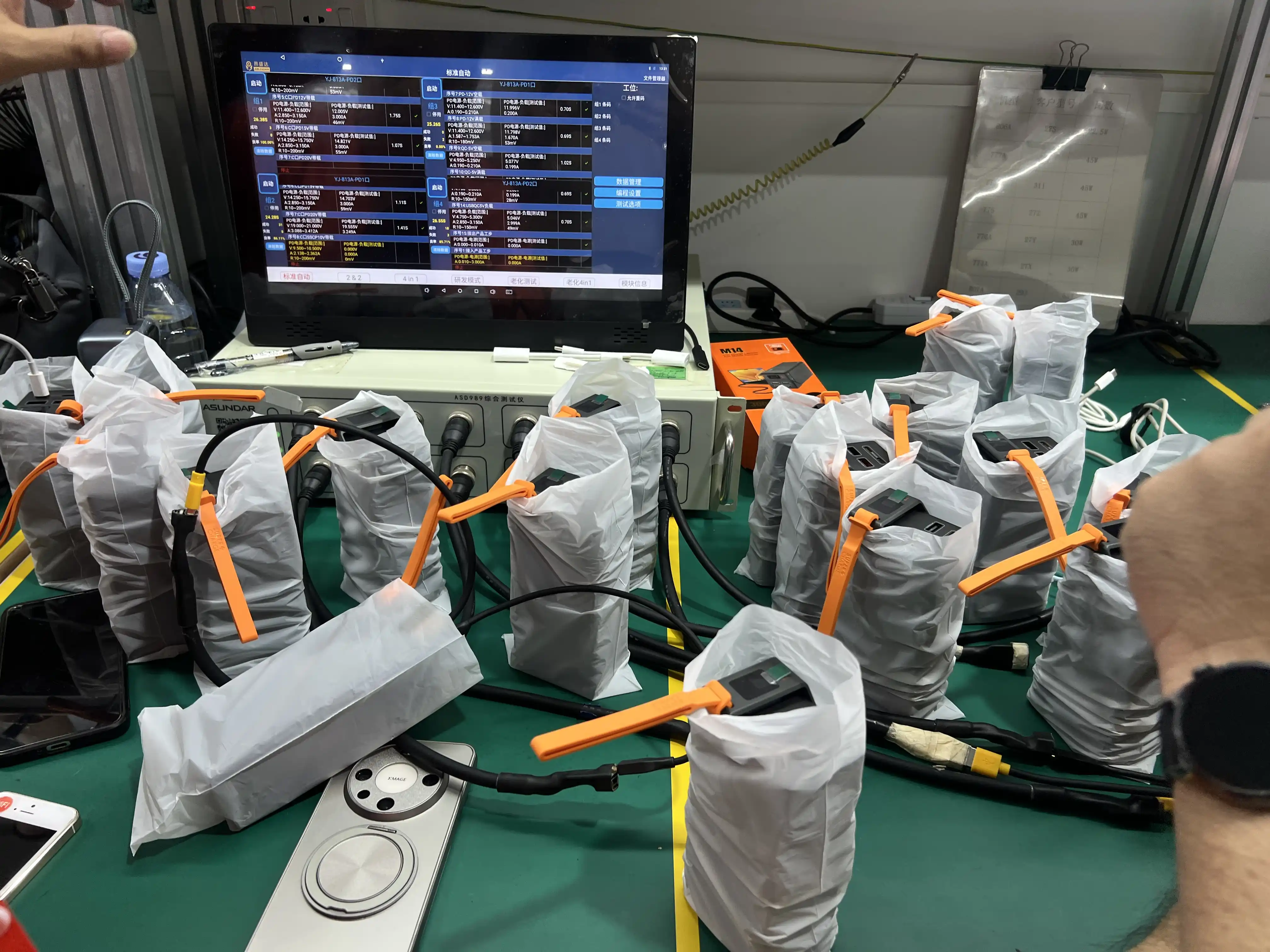
Multi-output PD 3.1 power bank QC sampling: verify simultaneous USB-C1 and USB-C2 output at rated wattage with Shared Capacity Protocol, dual-port verification is mandatory for all multi-port PD 3.1 OEM chargers
| Target Device / Market Segment | Max Charging Speed | OEM Protocol Requirement | Cable Spec (Include in Box) |
|---|---|---|---|
| iPhone 15/16 | ~27W | PD 3.0 + PPS | Any USB-C |
| Samsung Galaxy S25 | 45W | PD 3.0 + PPS | 5A e-marked |
| MacBook Air M4 | 30-45W | PD 3.0 | Any USB-C |
| MacBook Pro 14" | 67-96W | PD 3.0 SPR | 5A e-marked |
| MacBook Pro 16" | 140W | PD 3.1 EPR | EPR rated |
| Dell XPS / ThinkPad | 65-100W | PD 3.0 SPR | 5A e-marked |
| Gaming laptop (RTX 5070+) | 140-240W | PD 3.1 EPR | EPR rated |
OEM sourcing guidance: For brands targeting the smartphone-to-ultrabook segment (90% of unit volume), PD 3.0 SPR with 5A e-marked cable covers the addressable market. PD 3.1 EPR SKUs should be reserved for the premium workstation and gaming laptop segment, higher FOB cost ($16-35/unit) but stronger margins and less competition. Every SKU should include PPS support regardless of wattage tier, Samsung Galaxy compatibility depends on it.
WOWOHCOOL Factory Data: PD Handshake Compatibility Test Matrix (65W & 140W Reference Designs)
| Device | 65W GaN (SPR) | 140W GaN (EPR) | PPS Negotiated | AVS Negotiated |
|---|---|---|---|---|
| MacBook Pro 16" (M4 Max) | 65W (limited) | 140W (28V/5A) | , | ✅ |
| iPhone 16 Pro Max | 27W (9V/3A) | 27W (same) | ✅ | , |
| Galaxy S25 Ultra | 45W (PPS) | 45W (same) | ✅ | , |
| Dell XPS 17 | 65W (limited) | 130W (20V/6.5A) | , | ✅ |
| ThinkPad X1 Carbon Gen 13 | 65W (20V/3.25A) | 65W (SPR fallback) | , | , |
Test protocol: Each device tested at 30% battery with OEM charging cable, Chroma 63600 monitoring CC-pin handshake sequence. USB-IF TID verification: WOWOHCOOL (Dong Yi Technology) products are listed on usb.org/products. Handshake success rate across all tested devices: 100% (50-unit sample per reference design). PPS negotiation verified in 20mV step increments per USB PD 3.1 spec §10.2.
More resources: Read our What Is a GaN Charger? Complete Guide to understand why GaN + PD 3.1 is the ideal combination, GaN vs Silicon Charger Comparison for technology trade-offs, and USB-C PD Fast Charging Guide for cable recommendations.
WOWOHCOOL FACTORY STAT
WOWOHCOOL produces GaN chargers with PD 3.1 EPR support up to 240W, paired with EPR-rated 5A USB-C cables for guaranteed full-speed charging. All chargers support PPS + AVS for optimal compatibility across phones, tablets, and laptops. OEM/ODM available with custom branding from 20W to 240W. View our GaN charger product line →
Frequently Asked Questions
What's new in USB PD 3.1 compared to PD 3.0?
USB-C PD 3.1 introduces Extended Power Range (EPR), raising the maximum from PD 3.0's 100W to 240W (48V × 5A) through a single USB-C cable. Key additions: three new voltage levels (28V, 36V, 48V), Adjustable Voltage Supply (AVS) for 100mV fine-tuning above 15V, and mandatory EPR e-marker cables above 100W. PD 3.0 SPR (Standard Power Range) caps at 20V/100W and covers smartphones and ultrabooks. PD 3.1 EPR covers laptops, workstations, and gaming devices. PD 3.1 chargers are backward-compatible with PD 3.0 devices. By mid-2026, ~60% of new laptops support 140W+ USB-C charging, and PD 3.1 adoption in consumer electronics accessories exceeds 79-82%.
What wattage tier should OEM brands choose, 65W, 100W, 140W, or 240W?
65W (20V): baseline for ultrabooks, general office, lowest cost, highest volume. 100W (20V): mainstream laptops, conference rooms, covers ~95% of commercial laptops, FOB +15-20% vs 65W. 140W (28V): the B2B sweet spot for gaming/performance laptops in 2026, MacBook Pro 16-inch, Dell XPS, ThinkPad P-series, FOB ~$12-16/unit at MOQ 500. 240W (48V): niche workstation tier, only ~12% of shipments, limited device support. PD 3.0 SPR (65-100W) covers the smartphone-to-ultrabook volume tier at FOB $4-9/unit. PD 3.1 EPR (140W+) targets premium laptop SKUs at FOB $16-35/unit. For most brands: PD 3.0 for volume, PD 3.1 140W for flagship.
What cable do OEM brands need for PD 3.1 240W charging?
PD 3.1 EPR above 100W requires EPR-rated USB-C 2.1 cables with an e-marker chip certified for the charger's maximum voltage. Cable-OEM matching: 20-60W = standard USB-C 3A cable. 65-100W = 5A e-marked cable ($1-2 FOB). 140-240W = EPR e-marker cable rated for 240W ($2-4 FOB). Without the correct cable, the charger automatically downgrades to 60W regardless of its rating. Standard 100W cables cannot safely support EPR and may fail power negotiation. Always bundle the correct cable in-box, a 140W charger shipped with a 60W-rated cable generates negative reviews and returns. Verify EPR cable specs by checking the USB-IF TID at usb.org.
Does the EU mandate require PD 3.1 for laptops?
The EU Common Charger Directive 2022/2380 mandates USB-C with USB PD for all laptops sold in the EU from April 28, 2026, making PD 3.1 the de facto standard for any laptop-capable charger above 100W. While the directive doesn't explicitly require PD 3.1 over PD 3.0, laptops needing over 100W can only use PD 3.1 EPR. Additionally, EU Ecodesign 2025/2052 requires active efficiency ≥87% and standby ≤0.5W, thresholds that effectively mandate GaN-based PD 3.1 designs above 65W. For OEM brands targeting the EU market: any charger labeled 'laptop-compatible' above 100W must be PD 3.1 EPR. USB-A-only chargers and proprietary charging ports are now non-compliant for EU-bound products.
What three specs must OEM buyers verify when sourcing PD 3.1 chargers from factories?
(1) EPR support, the charger must deliver 28V, 36V, or 48V outputs (not just 20V SPR), confirmed via USB-IF TID lookup at usb.org. (2) AVS compliance, required for fine-grained voltage control above 15V in PD 3.1. (3) EPR e-marker cable pairing, the bundled cable must carry an EPR e-marker chip rated for the charger's maximum voltage. Without all three, the product defaults to 60W (3A) regardless of labeling. Also demand: test reports dated 2025 or later (early-batch PD 3.1 modules from 2023-2024 had known EPR mode entry bugs with Dell/HP laptops), 100% functional testing + aging under full load, and IEC 62368-1 test reports from accredited labs (SGS, TÜV, Intertek).
What certifications are required for PD 3.1 chargers in global markets?
EU: CE (LVD + EMC), IEC 62368-1:2023, EU Ecodesign 2025/2052 (≥87% active efficiency, ≤0.5W standby), IEC 62680-1-2 USB-IF interoperability. US: FCC, DOE/CEC efficiency Level VI. Strongly recommended: USB-IF TID certification (verify at usb.org), ENEC safety mark, EPR interoperability test reports from 2025+. Multi-market parallel certification (US+EU+UK): budget $8,000-15,000 total, saves 3-4 months vs sequential. WOWOHCOOL provides complete USB-IF TID documentation and compliance packs with every PD 3.1 OEM order.
What is the difference between PPS and AVS in PD 3.1?
PPS (Programmable Power Supply) is a PD 3.0 feature: adjusts voltage in 20mV steps from 3.3V to 21V, ideal for smartphone fast charging (Samsung Super Fast Charging, iPhone 27W). AVS (Adjustable Voltage Supply) is a PD 3.1 feature: adjusts voltage in 100mV steps from 15V to 48V, designed for laptops, monitors, and high-power devices, extending battery lifespan by 20-30% vs fixed-voltage charging. PPS = precision at low voltage; AVS = range at high voltage. Many PD 3.1 chargers support both. For OEM product specs: any charger above 65W should include AVS; any charger targeting smartphone users should include PPS.
How do OEM buyers source PD 3.1 GaN chargers from Shenzhen factories?
Step 1: Choose your wattage tier, 65-100W PD 3.0 for volume, 140W PD 3.1 EPR for flagship. Step 2: Verify USB-IF TID certification at usb.org before placing a deposit. Step 3: Demand EPR interoperability test reports dated 2025+, early-batch modules had known bugs. Step 4: Specify dynamic power allocation for multi-port chargers (updates every ~50ms), static allocation causes voltage drops and screen flickering. Step 5: Confirm the bundled cable matches the charger's max voltage. Leading Shenzhen GaN manufacturers offer MOQ from 200 pcs for trial orders. 140W GaN chargers: ~$12-16/unit FOB at MOQ 500, factory-direct eliminates 25-35% middleman markup. WOWOHCOOL provides PD 3.1 OEM from 65W to 240W with USB-IF certification and full CE/FCC/UL compliance documentation.
Supply Chain Expert · Wireless Charging Specialist
Nina Nico is a supply chain management expert with 10+ years experience helping global B2B clients source quality GaN chargers from WOWOHCOOL in Shenzhen, China. She holds a degree in International Trade and is a certified supply chain professional (CSCP).
Factory Footprint
ISO 9001 Facility
Shenzhen, China
Export Countries
Engineers In-House