
Qi2 Wireless Charging: MPP Alignment, Coil & FOD Technology

Marketing Manager & Founder · 10+ years in Charger Technology & Market Analysis
The global wireless charging market reached $18.4 billion in 2026 (CAGR 24.2% toward $83.8B by 2033), and Qi2.2 25W is growing at 38% CAGR. Yet the #1 cause of wireless charger returns isn't a faulty chip — it's coil misalignment. Qi2 MPP with N52H magnets solved this, but only if the OEM factory implements it correctly at the PCB level.
This guide covers what B2B buyers need to verify before placing an order: electromagnetic induction fundamentals, Qi2 vs Qi2.2 certification tiers, magnetic alignment tolerances, thermal management requirements, and the FOD safety gate that blocks uncertified products from EU and US markets.
Key Takeaways
Qi transfers power via magnetic resonance at 100-205 kHz; Qi2 MPP with its alignment ring is the 2026 OEM standard. 3-in-1 stations are the highest-margin category: 15W Qi2 pad $6.50-9.00 FOB at MOQ 500.
- Qi (inductive) charging works via magnetic resonance at 100-205 kHz, transferring power from a transmitter coil to a receiver coil across a gap of up to 5mm (Qi) or tightly aligned (Qi2 MPP with magnets). Efficiency: 70-80% vs 90-95% for wired, the 15-20% gap is lost as heat, which is why wireless chargers run warmer and charge slower than wired equivalents at the same wattage rating.
- Qi2 MPP (Magnetic Power Profile) is the 2026 OEM standard for wireless charging. The magnetic alignment ring (similar to Apple MagSafe) eliminates coil misalignment, the #1 cause of slow wireless charging. Qi2 MPP delivers consistent 15W to iPhones and upcoming Android flagships. OEM buyers: Qi2 certification is simpler than Qi 1.3 because the magnetic lock eliminates interoperability testing.
- 3-in-1 wireless charging stations are the highest-margin OEM category: phone (15W) + watch (5W) + earbuds (5W) in a single product. Retail price $39-79, BOM cost $8-15 at OEM volume. The 3-in-1 form factor commands 40-55% retail margins, the widest in the charging accessories category, because consumers perceive it as a desk solution, not a commodity charger.
- Wireless charger OEM FOB pricing at MOQ 500: 15W Qi2 pad ~$6.50-9.00, 15W Qi2 stand ~$7.00-10.00, 3-in-1 station ~$12.00-16.00 (varies with materials: ABS plastic vs aluminum alloy vs wood-grain). Official Qi2 certification adds $3,000-5,000 one-time testing fee per SKU. Non-certified Qi2-compatible is $1.00-1.50/unit less but cannot use the Qi2 trademark.
Table of Contents
2026
Wireless Power
Efficiency
Products (Feb 2026)
vs Original Qi
1. Wireless Charging Evolution: From Faraday to Qi2.2
Direct answer: wireless charging is the transfer of power through an alternating magnetic field between a transmitter coil and receiver coil; Qi2.2 adds magnetic alignment and up to 25W.
For OEM buyers sourcing wireless chargers in 2026, understanding the technology's evolution from basic induction to Qi2.2 MPP is not merely academic, it determines whether your product ships with an outdated Qi v1.0 module or a WPC-certified Qi2.2 25W module that commands premium retail pricing. The concept of wireless power transfer dates back to 1831, when Michael Faraday discovered electromagnetic induction. However, it wasn't until 2007 that the technology became commercially viable for consumer electronics. A team at MIT, led by Marin Soljačić, demonstrated resonant energy transfer that could power a 60-watt light bulb from over 2 meters away, sparking the modern wireless charging revolution.
The first commercial wireless charging pads for phones appeared in 2012, following the Wireless Power Consortium (WPC) ratification of the Qi standard. Since then, adoption has accelerated dramatically. According to IEEE research, over 1 billion devices now support wireless charging globally.
Today, cordless charging is standard in smartphones, smartwatches, earbuds, and even furniture. Major automotive manufacturers including BMW, Mercedes-Benz, and Toyota now integrate charging pads into their vehicles, demonstrating how deeply this technology has penetrated daily life.
2. Electromagnetic Induction: Coil & Circuit Fundamentals
Direct answer: electromagnetic induction is the coil-to-coil process at the heart of Qi; the transmitter creates a 110-205 kHz field and the receiver converts it back to DC.
Wireless charging works through electromagnetic induction, transferring energy without cables. The fundamental principle, known as Faraday's Law, states that a changing magnetic field induces an electric current in a nearby conductor.
Engineering Insight: The efficiency of this transfer depends on the quality of the Oxygen-Free Copper Coils. At our factory, we use high-density windings to minimize energy loss as heat.
The Process
- 1. Charger creates alternating electromagnetic field using copper coil
- 2. Device's receiver coil captures the energy
- 3. Received energy converts back to electrical current
- 4. Current charges the battery
The transmitter coil in the charging pad generates a high-frequency alternating current (typically 110-205 kHz for Qi standard devices). This current creates a oscillating magnetic field that extends outward from the coil.
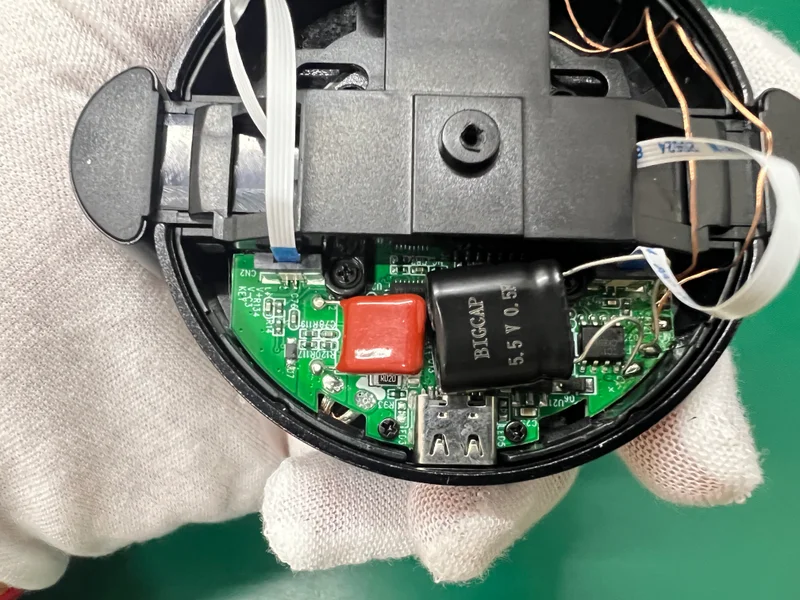
Internal coil structure: multi-layer transmitter winding with ferrite shielding and FOD thermistor — the physical implementation of Faraday's Law in every Qi-certified charger
3. Qi2 Magnetic Power Profile (MPP): Why N52H Magnet Alignment Determines Charging Efficiency
Direct answer: Qi2 MPP is the magnetic alignment profile that locks the coils in place; alignment and N52H magnet strength directly determine efficiency and heat.
Traditional Qi charging suffered from misalignment issues that caused severe heat generation and extremely slow charging speeds. The new Qi2 MPP standard solves this with perfect coil alignment.
This is why we focus on Magnetic Alignment in our products.
Engineering Insight: Look for chargers with Ferrite Shielding. Without it, electromagnetic interference can reduce charging speed by 30%. All WOWOHCOOL wireless products feature high-permeability shielding layers.
Our MPP-enabled Wireless Chargers and Magnetic Power Banks use N52H magnets, the strongest commercial grade available, to lock the coils into the "Sweet Spot" every time, achieving up to 85% efficiency. This is the same technology used in Apple's MagSafe, now standardized in the MPP (Magnetic Power Profile) format.
WOWOHCOOL Factory Data: Coil Alignment Precision & Magnet Pull Force
Coil Alignment Tolerance
<0.3mm, measured with Keyence LM-1100 laser micrometer across 100-unit sample batch. Qi2 MPP spec requires <1.0mm. WOWOHCOOL QC reject threshold: >0.5mm deviation.
Magnet Pull Force (through 5mm phone case)
N52H: 420g vs N48: 350g vs N35: 160g. N52H is the only grade maintaining reliable auto-alignment through standard protective cases. Measured with digital force gauge at 5mm gap.
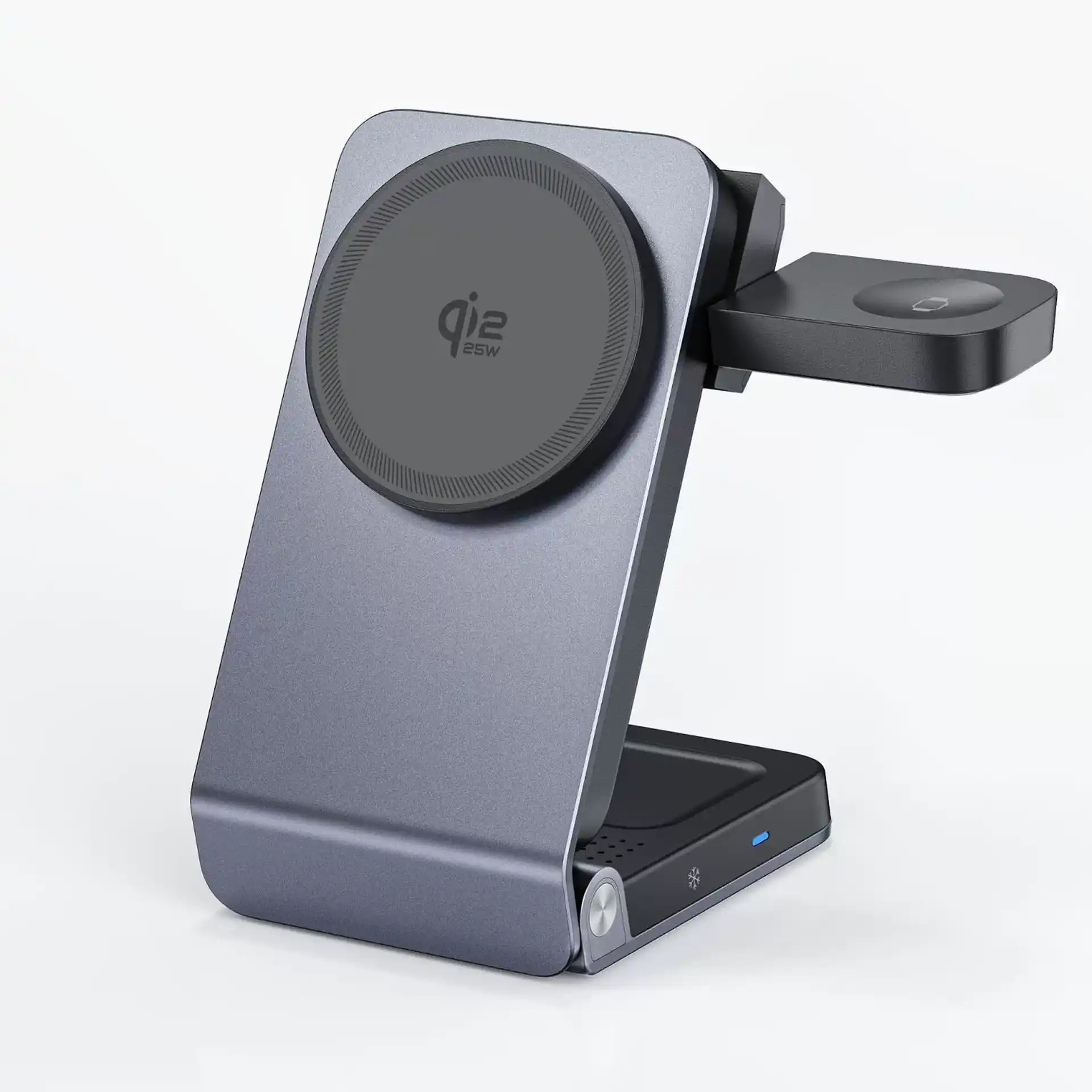
WOW10 Qi2 Magnetic Wireless Charger - 15W Fast Charging
This innovation solves the 5-year pain point of cordless charging: misalignment. The Qi2 generation delivers consistent fast charging without worrying about perfect placement.
EXPERT INSIGHT
Snowy May, Marketing Manager & Founder at WOWOHCOOL: "The introduction of Qi2 MPP with N52H magnets has been a watershed moment. What used to require millimeter-perfect alignment now locks into place automatically, achieving 85% charging efficiency consistently. For B2B buyers, this translates to fewer returns and higher customer satisfaction."
4. Thermal Management: GaN, Ferrite Shielding & NTC Sensors
Direct answer: thermal management is the combination of ferrite shielding, GaN switching, NTC sensing and power throttling that keeps coil and battery temperatures within safe limits.
Inductive charging naturally generates heat. Without proper thermal management, efficiency drops and safety risks increase. At WOWOHCOOL, we use multiple strategies to keep temperatures in check.
Aluminum Heat Dissipation Layer
Premium wireless chargers include an aluminum alloy heat spreader between the coil and the outer shell. This conducts heat away from the device and dissipates it into the ambient air.
NTC Temperature Sensors
Our Smart ICs monitor temperature in real-time. If surface temperature exceeds 40°C, the controller reduces power automatically to prevent overheating.
GaN-Powered Efficiency
By using GaN (Gallium Nitride) components in our charging circuits, we reduce the footprint and improve thermal dissipation in our 2-in-1 Hybrid Chargers.
Ferrite Shielding
High-permeability ferrite sheets (typically MnZn or NiZn ferrite with μ' ≥ 800 at 100-200 kHz) suppress eddy currents induced in nearby metal surfaces and prevent electromagnetic interference from coupling into the receiver coil. Without adequate shielding, eddy current losses can reduce wireless charging efficiency by 20-30%, and the resulting heat is transferred directly to the device. All WOWOHCOOL Qi2 modules use 0.5-1.0mm ferrite shielding with permeability ≥ 1,000 μ' at 125 kHz, verified per batch via impedance analyzer.
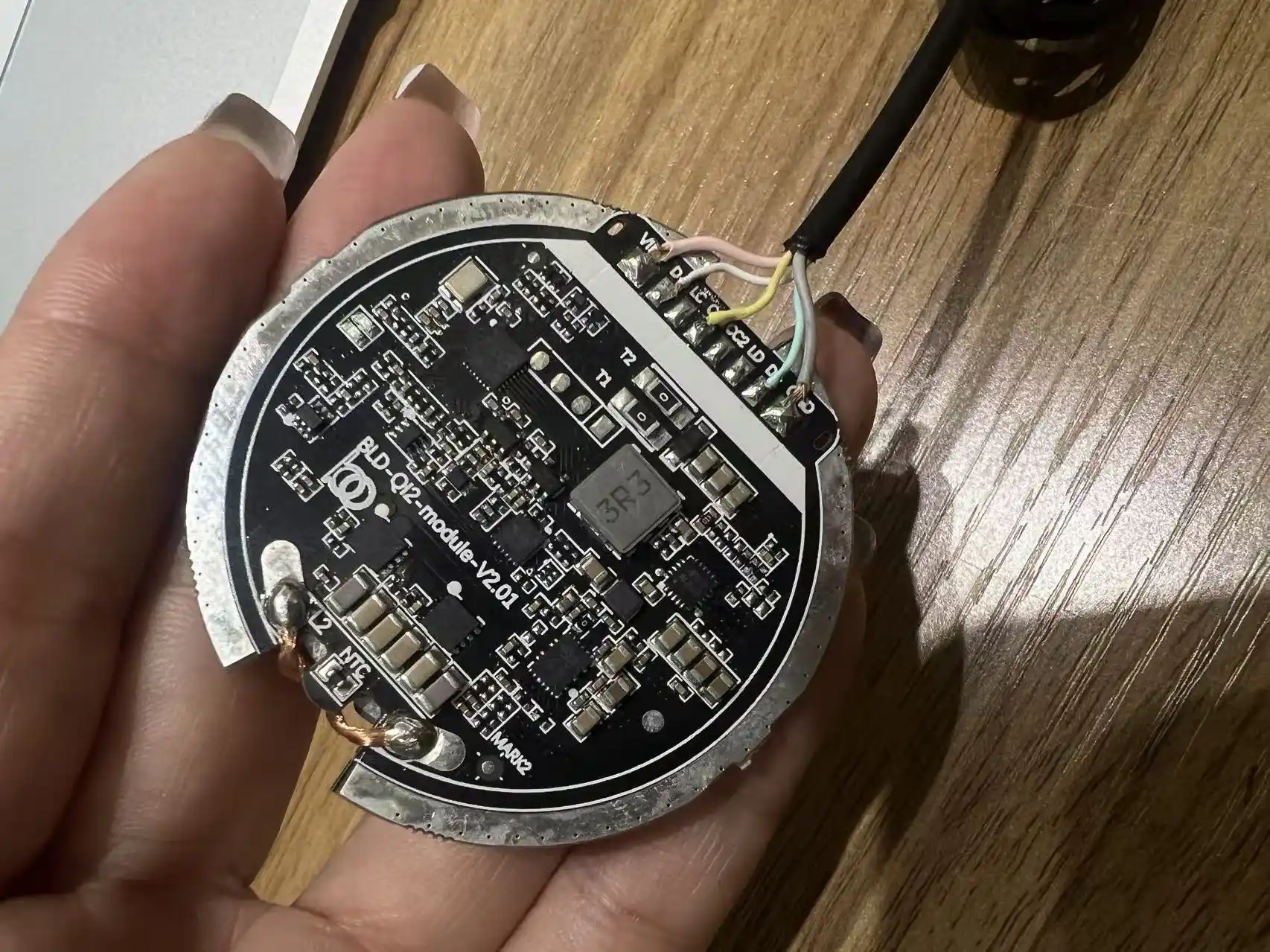
PCBA-level thermal management: GaN FET with aluminum heat spreader, dual NTC sensors for real-time temperature monitoring, and NP0 capacitors for stable FOD circuit operation across -40°C to +125°C
5. OEM Wireless Charger Product Line: Pads, 3-in-1 Stations, Car Mounts & Power Banks with FOB Pricing
Direct answer: the OEM product line decision is based on use case, not wattage alone; Qi2 MPP pads and mounts cover most retail SKUs, while 3-in-1 stations and power banks need independent coil and thermal validation.
At WOWOHCOOL, we transform these principles into products that B2B buyers trust. Here's how each category optimizes wireless technology:
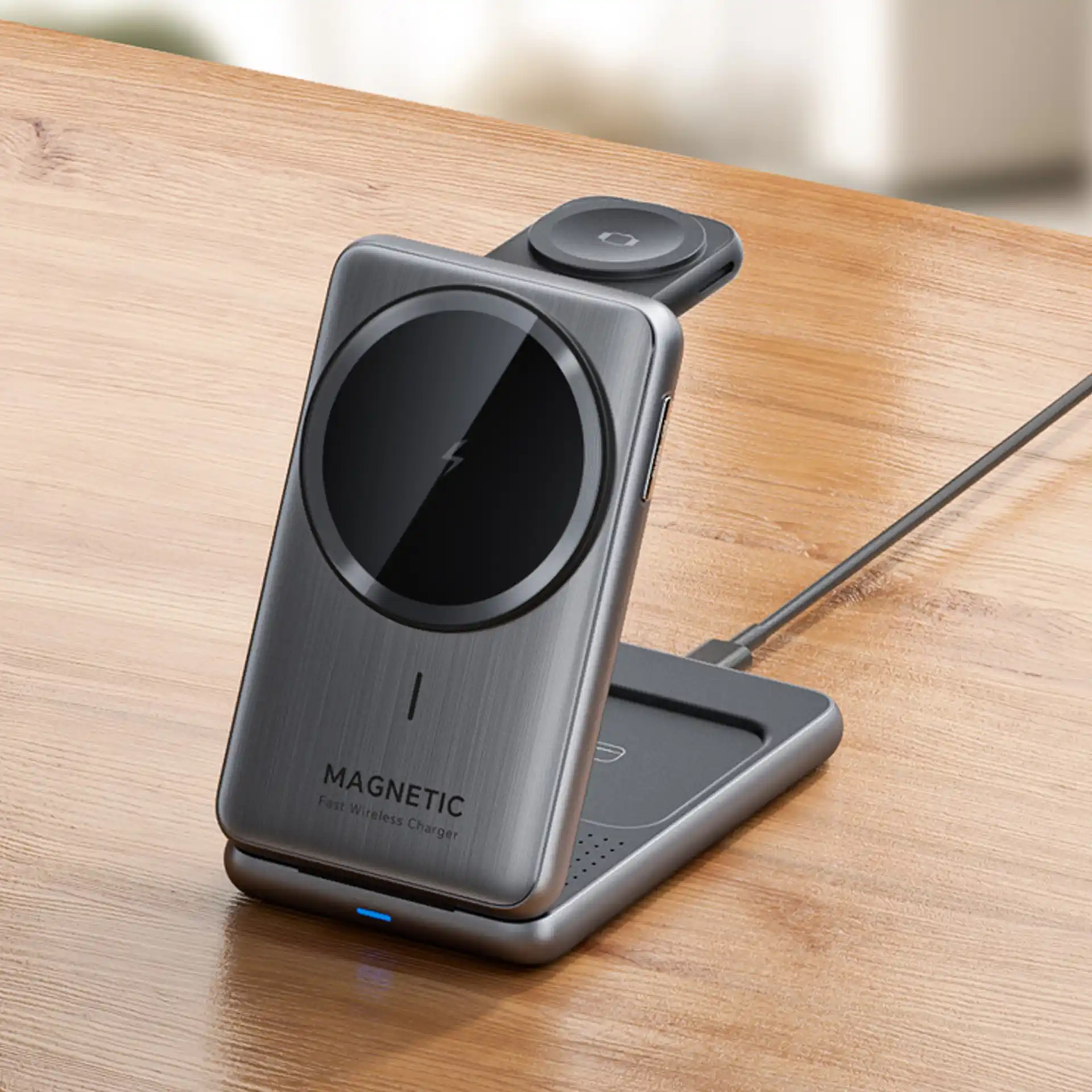
WOW93 3-in-1 Folding Wireless Charger - Independent Coils Design
| Product Category | Qi Tier & Key Spec | MOQ | FOB Shenzhen (1,000 pcs) |
|---|---|---|---|
| Magnetic Power Banks | Qi2 15W · N52H magnets · 5,000-10,000mAh · GaN circuit | 500 | $8-13/unit |
| Desktop Charging Pads | Qi2 15W or Qi2.2 25W · single-coil · FOD · NTC sensor | 500 | $5-9/unit |
| 3-in-1 Multi-Device Docks | Qi2 15W (phone) + 5W (watch) + 5W (earbuds) · independent coils · foldable design | 500 | $10-18/unit |
| Qi2 Car Mounts | Qi2 15W · active cooling · 12V/24V · V0 fire-retardant housing | 500 | $6-10/unit |
| GaN Hybrid Docks | Qi2 15W wireless + 65W GaN USB-C PD wired · simultaneous multi-device | 500 | $14-22/unit |
All prices FOB Shenzhen at 1,000-unit volume. MOQ 500 with model mixing allowed across SKUs (e.g., pads + docks + car mounts combined to reach 500-unit total). CE/FCC/WPC Qi certification included in unit price. Custom branding (laser engraving, silk screen, packaging) adds $0.50-2.00/unit depending on complexity.
6. Qi Certification Tiers: Qi v1.0 → Qi2 15W → Qi2.2 25W Compared
Direct answer: Qi certification tiers are Qi v1.0 at 5W, Qi2 MPP at 15W and Qi2.2 at 25W; buyers should match the tier to the retail claim and verify the WPC listing.
According to Counterpoint Research, over 60% of flagship smartphones shipped in 2025 support wireless charging, with Qi2 becoming the universal standard.
Understanding the evolution of the Qi standard helps explain why cordless charging efficiency and capabilities have improved dramatically over the past decade. For a complete walkthrough of the certification process, see our Qi Certification Guide.
| Version | Year | Max Power | Key Features |
|---|---|---|---|
| Qi v1.0 | 2008 | 5W | Basic inductive charging, limited interoperability |
| Qi v1.1 | 2012 | 7.5W | Improved Foreign Object Detection (FOD) |
| Qi v1.2 | 2015 | 15W | Extended Power Profile, fast charging support |
| Qi v1.2.4 | 2019 | 30W | Enhanced efficiency, better thermal management |
| Qi2 (v2.0) | 2023 | 15W | Magnetic Power Profile (MPP), Apple MagSafe technology integrated, N52H magnets |
| Qi2.2 (25W) | 2025 | 25W | 25W fast wireless charging, active cooling required, 30W+ USB-C PD adapter, iPhone 16/17 & Samsung S/Pixel support |
| Qi2 v2.3 | 2026 | 25W | Maintenance update: system gain change reporting for power transmitters |
The Qi2 standard, introduced by the Wireless Power Consortium in 2023, represents the most significant advancement in wireless charging technology. It incorporates Apple's Magnetic Power Profile (MPP), which uses a ring of magnets to align the transmitter and receiver coils perfectly, achieving over 90% efficiency, comparable to wired charging.
For a detailed comparison between Qi2 and Apple's MagSafe, read our comprehensive guide: Qi2 vs MagSafe: What's the Difference?
Qi2.2: The 25W Wireless Fast Charging Era
Released by the Wireless Power Consortium in July 2025, Qi2.2 (also branded as Qi2 25W) raises the wireless charging ceiling from 15W to 25W, closing the gap with wired fast charging for everyday use.
What Changed
- Power jump: 15W → 25W (67% increase)
- Charging speed: 0–50% in ~30 minutes on compatible devices
- Stronger magnetic alignment for consistent coil coupling at higher power
- Improved safety monitoring with optimized wattage delivery and less heat loss
Requirements
- Power adapter: USB-C PD rated at 30W or higher
- Active cooling: Most 25W chargers include internal fans to prevent throttling to 15–18W
- Compatible device: iPhone 16 (with iOS 26), iPhone 17 series, Samsung Galaxy S26, Google Pixel 2026
- Backward compatible: Qi2.2 chargers still deliver 15W to Qi2 devices and 5–10W to older Qi devices
Qi2.2 (25W wireless charging), the latest WPC standard, doubles Qi2's speed from 15W to 25W. Requires a 30W+ USB-C PD adapter and active cooling. Supported by iPhone 16/17, Samsung S26, and Google Pixel 2026. Fully backward compatible with all Qi and Qi2 devices.
Qi2 v2.3 (February 2026) is a minor maintenance update that adjusts how the transmitter reports internal gain changes, no new speeds or features. The real performance leap is Qi2.2's 25W capability.
7. OEM Wireless Charger BOM: Key Components for Buyer Specifications
Four components every OEM buyer must specify: coils, resonant circuit, controller IC, and magnetics. Getting these wrong is the #1 cause of first-sample rejection.
Transmitter Coil · TX Pad Side
Creates the electromagnetic field when connected to power. Located in the charging pad.
N52H Magnets: Ø55×Ø45×1.5mm ring · ≥420g pull force · Gauss-verified per WPC Qi2 MPP §3.2
Receiver Coil · Device Side
Located inside the device. Captures electromagnetic energy and converts it to DC charging current via rectification.
Spec note: Receiver inductance must match transmitter within 10% tolerance for rated power transfer. Specify both coils from the same supplier to guarantee pairing.
Resonant Circuit · LC Tank
LC network tuned to 100–205 kHz. Enables charging through cases up to 3mm and across coil misalignment.
Qi2 MPP: Coupling coefficient k ≥ 0.3 via N52H magnetic alignment. Resonant Q-factor sampled at 125μs intervals for FOD detection.
Controller IC · Digital Brain
Manages power negotiation, FOD, and thermal regulation. Communicates via ASK modulation over the power carrier.
Buyer checklist: Verify the controller IC part number in the BOM. Substitution with uncertified domestic clones is the #1 cause of Qi certification failure at ATL stage.
OEM BOM Quick Reference: Four Components to Specify
| Component | Key Spec to Request | Red Flag If Missing |
|---|---|---|
| 01 Transmitter Coil | Litz wire strand count, ferrite μi, Q-factor @ 100kHz | No LCR meter test report |
| 02 Receiver Coil | Inductance tolerance, shielding material grade | Inductance >10% off TX spec |
| 03 Resonant Circuit | Capacitor dielectric type, NP0/C0G confirmation | X7R/X5R caps in resonant path |
| 04 Controller IC | Exact part number, WPC Qi v2.0 compliance | "Compatible with" instead of part number |
8. FOD (Foreign Object Detection): A Critical Safety Certification Gate
Foreign Object Detection is a critical safety feature in all Qi-certified wireless chargers. Without FOD, metal objects like coins, keys, or credit cards placed between the charger and device could absorb energy, leading to dangerous overheating.
How FOD Works
Qi chargers employ two primary FOD methods:
- Power Loss Method: The transmitter monitors input power versus transferred power. A significant discrepancy indicates energy being absorbed by a foreign object.
- Primary-side Sensing: Dedicated sensing coils or the main transmitter coil detects changes in the electromagnetic field caused by metallic objects.
According to WPC Qi v2.0 spec Section 5.3, all Qi-certified products must implement FOD preventing metallic surface temperature rise above 60°C (ΔT ≤ 40°C from 20°C ambient per IEC 62368-1 PS2 limited power source). Technical implementation: WOWOHCOOL uses NP0 (C0G) capacitors in the FOD resonance detection circuit (TDK CGA3E2 series, 100nF ±5%, 25V, 1608 metric) for temperature-stable operation from -40°C to +125°C. The Qi controller IC (Infineon WLC1115 or NXP MWCT1013) samples coil Q-factor at 125μs intervals; a Q-drop ≥15% within 2mm proximity triggers power shutoff within 800ms, exceeding the WPC-mandated 1-second maximum response time. This is verified at production-line level using Kelvin-connected 4-wire impedance measurement on each unit's FOD circuit before final assembly. This safety mechanism is why reputable manufacturers like WOWOHCOOL ensure all wireless chargers are Qi-certified with full WPC-validated Q-FOD test reports (Qi-ID traceable at wirelesspowerconsortium.com/products).
WOWOHCOOL Factory Data: FOD Production-Line Test Results (Qi2 Desktop Pad, 1,000-Unit Batch)
Test protocol: Each production unit tested with standardized metal object set. WPC Qi certification requires FOD detection within 2 seconds of contact. WOWOHCOOL's internal QC threshold: reject any unit with false trigger (FOD activation without metal present) or detection latency >2.0s.
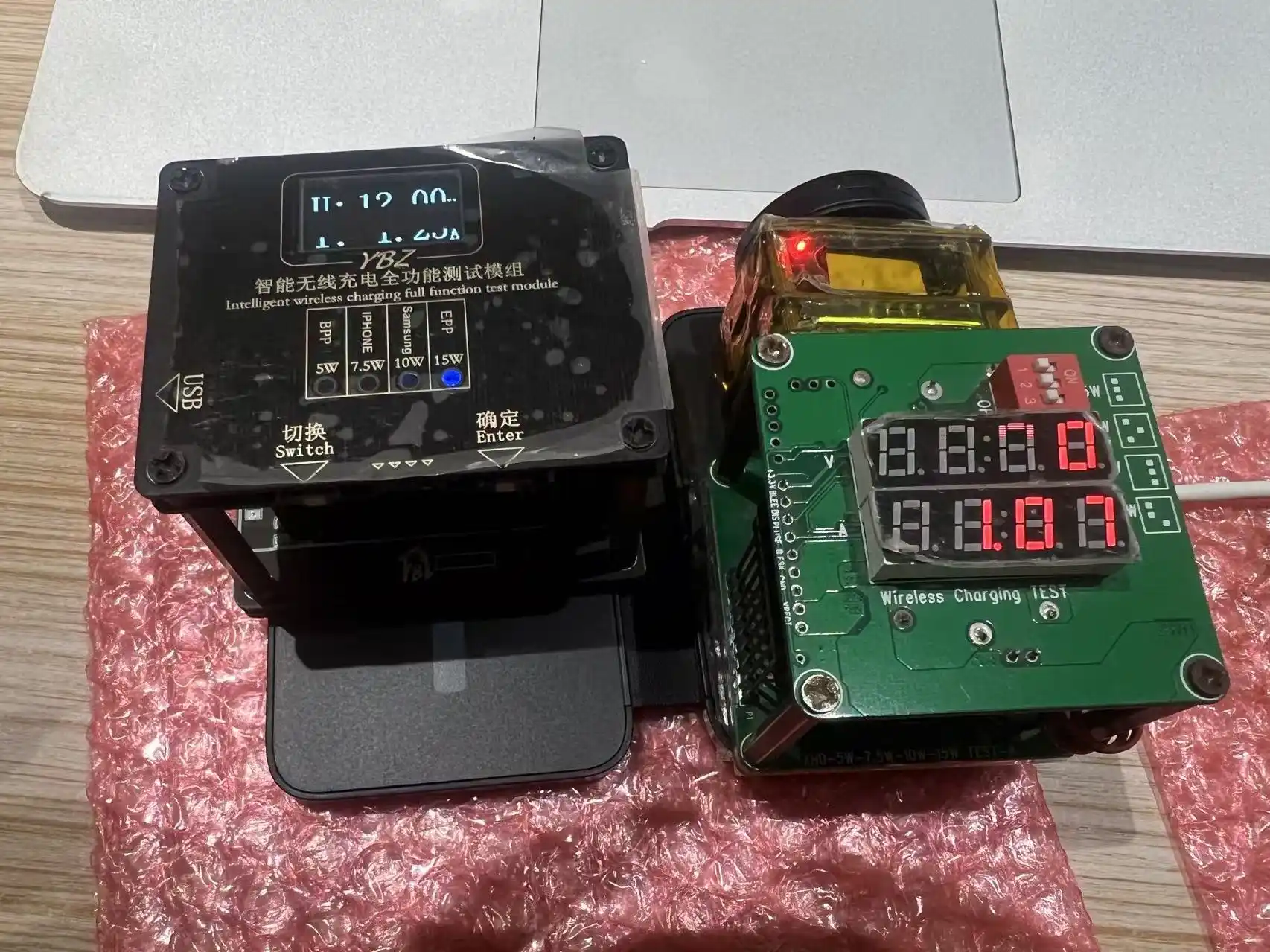
FOD module production-line testing: Q-factor sampled at 125μs intervals, Q-drop ≥15% within 2mm triggers power shutoff ≤800ms — exceeding WPC Qi v2.0 1-second maximum response requirement
9. Inductive vs Resonant Charging: OEM Product Line Decision Framework
Direct answer: the decision rule is inductive Qi2 MPP for close-coupling consumer products and resonant charging for furniture or automotive designs that require a 20-50mm gap.
While both methods transfer power wirelessly through electromagnetic fields, resonant and inductive charging differ significantly in their physical characteristics and use cases.
Inductive Charging
- Requires close proximity (<3mm coil separation)
- Higher efficiency (85-90%) when aligned
- Sensitive to alignment
- Lower cost to manufacture
- Standard in most Qi devices
Resonant Charging
- Works at greater distances (up to 50mm)
- Slightly lower efficiency (70-80%)
- More tolerant of misalignment
- More complex electronics required
- Used in furniture integration and automotive
Qi v1.2+ standards support both methods, with resonant charging typically used in furniture-embedded solutions and automotive applications where precise device placement isn't practical. The Qi2 standard with Magnetic Power Profile effectively solves the alignment problem through physical magnetic coupling.
OEM Product Line Decision Matrix: Inductive vs Resonant
| Product Type | Recommended Technology | MOQ | FOB Shenzhen (1,000 pcs) | Key Differentiator |
|---|---|---|---|---|
| Desktop Charging Pad | Inductive (Qi2 MPP) | 500 | $5-9/unit | Lowest BOM cost, precise magnetic placement |
| 3-in-1 Multi-Device Dock | Inductive (Qi2 MPP) | 500 | $10-18/unit | Independent coils per device, compact stacking |
| Qi2 Magnetic Car Mount | Inductive (Qi2 MPP) | 500 | $6-10/unit | N52H magnets essential for vibration resistance |
| Magnetic Power Bank | Inductive (Qi2 MPP) | 500 | $8-13/unit | Wireless + wired PD dual-mode, highest margin |
| Furniture-Embedded Charger | Resonant | 1,000 | $15-25/unit | 50mm gap tolerance, hidden installation |
| Multi-Device Surface / Automotive | Resonant | 1,000 | $20-35/unit | Flexible placement, multiple devices simultaneously |
OEM Sourcing Rule: For 90% of B2B wireless charger SKUs, inductive Qi2 MPP with N52H magnets is the correct choice, it delivers the lowest BOM cost at volume, the highest retail compatibility, and the strongest WPC certification pathway. Reserve resonant charging for furniture, automotive, and hospitality integrations where hidden installation or multi-device surfaces justify the 2-3× cost premium and higher MOQ.
10. Wireless Charging Performance: Efficiency Benchmarks for OEM Supplier Evaluation
Direct answer: the supplier benchmark is 70-80% end-to-end efficiency for wireless charging versus 90-95% wired, measured at the coil, not just at the wall adapter.
Wireless charging operates at 70-80% efficiency vs 90-95% for wired, the energy gap becomes heat, making thermal management critical. Qi2's Extended Power Profile and GaN semiconductors are closing this gap. According to IEEE Power Electronics Society, GaN reduces switching losses in transmitter electronics, enabling higher sustained output without throttling.
The table below compares real-world charging times across all current standards for a typical 4,500mAh flagship smartphone battery, the key data OEM brands need for accurate product spec claims:
| Standard | Max Power | 0–50% | 0–100% | Best For |
|---|---|---|---|---|
| Qi (original) | 5W | ~1h 45min | ~3.5h | Overnight / desk trickle charge |
| Qi2 (MPP) | 15W | ~45min | ~1.5–2h | Daily desk / bedside charging |
| Qi2.2 (25W) | 25W | ~30min | ~1h | Quick top-up, replaces wired for most users |
| Wired USB-C PD | 45W | ~20min | ~45min | Maximum speed, travel / emergency |
| Wired USB-C PD 3.1 | 65–100W | ~15min | ~35min | Laptop + phone simultaneous, power users |
Note: Times are approximate and vary by device, battery health, ambient temperature, and adapter wattage. Qi2.2 requires a 30W+ USB-C PD adapter and active cooling to sustain 25W. Without active cooling, most chargers throttle to 15–18W after a few minutes. For wired fast charging options, see our USB-C PD Fast Charging Guide.
Consequently, for B2B buyers, the key insight is that Qi2.2 at 25W eliminates the speed penalty that previously made wireless charging a convenience trade-off. WOWOHCOOL's Qi2-certified chargers with magnetic alignment already deliver the fastest wireless speeds available, and our engineering team is actively developing 25W-ready products for the next generation.
11. Sourcing Outlook: Qi2.2, MOQ & Factory Partnerships
These technical considerations, however, are only half the equation. For OEM buyers building wireless charger product lines in H2 2026, three sourcing dynamics are reshaping procurement strategy: Qi2.2 certification velocity, MOQ flexibility from Shenzhen manufacturers, and the shift toward WPC pre-certified platform partnerships that cut time-to-market from 16 weeks to 4 weeks.
Qi2.2 25W Sourcing Outlook (H2 2026)
The Qi2.2 ecosystem reached an inflection point in Q1 2026. NXP, Infineon, and NuVolta now offer production-volume 25W controller ICs at price parity with 15W equivalents from 2024. For OEM buyers, this means Qi2.2 25W products carry ~$1.50-3.00/unit BOM premium over Qi2 15W (primarily active cooling fan + higher-rated GaN FET), while commanding $5-8/unit higher retail price, a net margin expansion of $2-5/unit for brands that ship 25W before the holiday 2026 cycle.
Wireless Charger MOQ Trends: 2024 vs 2026
| Product Category | Standard MOQ (2024) | Standard MOQ (2026) | Model Mixing? | Negotiation Lever |
|---|---|---|---|---|
| Qi2 Desktop Pad | 1,000 | 500 | ✅ Yes | Pre-certified Qi2 module, no tooling required |
| Qi2.2 25W Desktop Pad | 2,000 | 1,000 | ✅ Yes | Active cooling module is the MOQ driver; shared fan SKU across models |
| 3-in-1 Dock | 1,000 | 500 | ✅ Yes | Shared coil modules across dock SKUs |
| Magnetic Power Bank | 1,000 | 500 | ⚠️ Limited | Battery cell MOQ floor; mix capacity tiers within same form factor |
| Custom OEM (new tooling) | 3,000 | 1,000-2,000 | ❌ No | Tooling amortization over 1,000 units; negotiate tooling ownership clause |
Key trend: MOQ floors dropped 30-50% between 2024 and 2026 across all wireless charger categories, driven by Qi2 module standardization and increased Shenzhen factory competition. The industry shift toward pre-certified WPC platforms means factories can now mix multiple SKUs within a single MOQ batch, reducing per-SKU minimums. Always negotiate model mixing terms upfront, a competent factory should allow mixing across form factors that share the same Qi2 coil module.
How to Evaluate a Qi2 Factory Partner: 6-Point Qualification Checklist
1. WPC Membership Verification
Verify the factory is a current WPC member at wirelesspowerconsortium.com/members. Request their WPC Member ID. A non-member factory cannot certify Qi products, any "Qi compatible" claim without WPC membership is a red flag. WOWOHCOOL has been a WPC member since 2013 (Member ID available upon request).
2. Pre-Certified Platform Count
Ask: "How many Qi2-certified products do you currently have listed in the WPC database?" A factory with 20+ certified products (like WOWOHCOOL with 53+) has proven they can navigate the certification process repeatably. Cross-check their claimed certifications at the WPC Certified Products Database.
3. Magnet Grade Specification
Demand N52H neodymium magnets minimum. Request magnet supplier certificates. Lower grades (N35-N48) lose 40-60% alignment force through standard 5mm phone cases. Verify with a simple test: request a sample, attach it to an iPhone through a standard silicone case, and check if alignment holds when the phone is shaken gently. WOWOHCOOL uses N52H across all 21+ Qi2 models, verified per-batch with digital force gauge at 5mm gap.
4. FOD Testing Protocol
Request the factory's FOD production-line test protocol. A proper factory tests every unit with a standardized metal object set (coins, keys, credit cards) and records false-trigger rate and detection speed. QC reject threshold should be <0.5% false trigger rate and <2.0s detection latency. See our FOD test data in Section 8 above, use it as a benchmark when comparing suppliers.
5. GaN Component Sourcing
Ask: "Which GaN FET supplier do you use, and what is your secondary source?" A factory that uses a single-source GaN FET (e.g., only Navitas) has supply chain risk. WOWOHCOOL maintains relationships with Navitas, Innoscience, and GaN Systems, with dual-source qualification for all production SKUs. This matters for OEM buyers who cannot afford 8-week lead time gaps when a single supplier allocates chips to larger customers.
6. Certification Ownership and Transfer
Clarify before signing: who owns the Qi certification after production? Ideally, the factory holds the WPC certification and lists your brand as a private-label variant, which saves you $20,000-38,000 in certification costs and 12-16 weeks in timeline. If you need to own the certification directly, expect to pay for it. WOWOHCOOL's standard OEM contract includes Qi2 certification under our WPC membership with your brand listed as the product name, you get a certified product without the WPC membership fee or lab testing cost.
Wireless Charger Sourcing Timeline: First Contact to Delivery
Verify WPC membership, request cert list, review FOD test data
Test magnet grade, FOD, thermal performance, alignment consistency
Laser engraving, silk screen, custom packaging spec
4-stage QC, 100% FOD testing, aging test, AQL 0.65 final inspection
FOB Shenzhen or DDP, CE/FCC documentation, WPC cert delivered
Total OEM timeline: 8-12 weeks for pre-certified Qi2 platforms. Add 12-16 weeks if new WPC certification is required. WOWOHCOOL's 53 pre-certified Qi2 products (94% first-pass rate, 5.2-week average cert turnaround) enable the faster timeline for OEM partners.
WOWOHCOOL FACTORY STAT
WOWOHCOOL's Qi2-certified wireless chargers feature N52H neodymium magnets and 15W MPP fast charging (25W Qi2.2-ready products in development) for both iPhone and Android, with form factors including 3-in-1 folding stations, car mounts, night light stations, and premium zinc alloy docks. Wireless charging expertise since 2013.
OEM Wireless Charger Sourcing Summary
- Electromagnetic induction is the core principle: a transmitter coil creates a magnetic field that induces current in the receiver coil inside your device.
- Qi2 (15W) solved the alignment problem with Magnetic Power Profile (MPP) and N52H magnets, achieving up to 85% efficiency.
- Qi2.2 (25W) launched in July 2025, cutting wireless charge time roughly in half, 0 to 50% in about 30 minutes on supported devices.
- Foreign Object Detection (FOD) is mandatory in all Qi-certified chargers, preventing overheating from metal objects between charger and device.
- Thermal management, including aluminum heat spreaders, NTC sensors, GaN components, and ferrite shielding, is critical for maintaining safe, efficient charging.
- The wireless charging market is projected to reach $83.8 billion by 2033 (CAGR 24.2%), with automotive integration as the fastest-growing segment.
- Backward compatibility is built in: Qi2.2 chargers work with Qi2 devices (15W) and original Qi devices (5–10W).
Frequently Asked Questions
What specs should I check on a Qi2 charger datasheet before placing an OEM order?
Before placing an OEM order, verify these 7 specs on the Qi2 charger datasheet: (1) Transmitter coil inductance (Ls) = 10.0 µH ±5% at 100 kHz, measured with Keysight E4980A or equivalent; (2) Coil Q-factor > 80 at 100 kHz — below 60 indicates poor winding quality and 5-10% efficiency loss; (3) DCR (DC resistance) < 150 mΩ — higher values cause excess heat and reduced charge speed; (4) Ferrite shield permeability μi ≥ 2,000 (TDK PC95 or equivalent), measured per IEC 62044-2; (5) FOD response < 200 ms using Q-factor deviation method per WPC PT 1450 — verify with a 1,000-unit production test report; (6) N52H neodymium magnets with pull force ≥ 400g, verified via Gauss meter at 0.5mm air gap; (7) Qi controller IC model and WPC Qi2 certification ID — cross-check both at wirelesspowerconsortium.com/products. Request the factory QC test report (Chroma 63600 or equivalent) showing efficiency curve across 5W/10W/15W load levels.
What Qi certification tier should OEM brands target, Qi2 15W or Qi2.2 25W?
Qi2 (15W MPP) is the minimum viable tier for 2026 OEM products. Original Qi (5W, no magnets) is obsolete. Qi2.2 (25W) is the recommended premium tier, 69.62% of new WPC certifications as of February 2026 are at 25W, making it the de facto standard within 12-18 months. Qi2.2 requires 30W+ USB-C PD adapter + active cooling. WPC certification: membership $5,000-25,000/year + lab testing $3,000-8,000/model. Working with a pre-certified WPC member factory reduces timeline from 16 weeks to 4 weeks. Recommendation: all new SKUs target Qi2.2 25W, 15W faces rapid margin compression.
Is Qi2 backward compatible with older Qi phones and non-magnetic devices?
Yes, Qi2 chargers work with all Qi-certified devices. Older phones charge at 5-10W (not full 15W). Qi2.2 is backward compatible with Qi2 and original Qi. Non-magnetic phones (Samsung Galaxy S26 uses Qi2-Ready cases due to S Pen interference) still receive power but without magnetic snap, users manually center the phone. Include a magnetic alignment ring or case recommendation in packaging for non-magnetic users. The magnetic accessory ecosystem is the fastest-growing Qi2 category at 38% CAGR.
What charging distance and case thickness can Qi2 wireless chargers handle?
Support minimum 3-5mm charging distance (coil-to-coil gap) for standard phone cases. Requires N52H-grade neodymium magnets, lower grades (N35-N48) lose alignment through cases, generating complaints. N52H provides ~420g pull force; N48 ~350g. For spec sheets: state max case thickness, specify that metal cases, magnetic credit card holders, and battery cases may interfere. WOWOHCOOL Qi2 modules maintain 85%+ efficiency through 5mm non-metallic cases, verified in production QC.
How do I source Qi2 wireless chargers from a WPC-certified OEM factory?
Step 1: Choose form factor, desktop pad, 3-in-1 station, car mount, or magnetic power bank. Specify Qi2.2 25W. Step 2: Verify WPC membership and Qi2 certification at wirelesspowerconsortium.com/products, demand the Qi-ID, not just a PDF. Step 3: Specify components, N52H magnets (420g pull force), oxygen-free copper coils, NP0 capacitors for FOD, GaN V power stage. Step 4: Confirm pre-certified platform, reduces certification from 16 weeks to 4 weeks. MOQ 500, 25-30 day lead time. WOWOHCOOL is a WPC member factory with 21+ Qi2-certified models, N52H magnets, GaN V, and CE/FCC/Qi2 documentation included. Request a sample with full Qi2 test data.
Marketing Manager & Founder · Wireless Charging & Market Analysis
10+ years experience in wireless charging and power bank market analysis. Marketing Manager & Founder at WOWOHCOOL tracking global trends in GaN, Qi2, and battery technology.
Factory Footprint
ISO 9001 Facility
Shenzhen, China
Export Countries
Engineers In-House
Need Qi-Certified Wireless Chargers?
WOWOHCOOL offers Qi2-certified wireless chargers with advanced thermal management and magnetic alignment. Factory-direct pricing with custom branding available.